Practice worksheet
Xiangqi Horse-Leg Blocking: 10 Move-Checking Exercises
Find the correct leg, distinguish blockers from destination pieces, and check ten original partial boards. Includes same-leg pairs, board edges, river crossing and two horse routes with different blockers.
Check the leg, not just the L-shaped destination
A Xiangqi horse moves one intersection orthogonally, then one diagonally outward. The first intersection is its leg, and any piece occupying that leg blocks the route. The final displacement is two files and one rank, or one file and two ranks. An L-shaped destination alone is not enough: unlike a chess knight, the horse cannot jump over its leg blocker.
This worksheet gives ten original, coordinate-labelled partial positions. Work out the leg, inspect its occupancy, then check the destination. The Xiangqi.com pieces-and-moves guide explains the horse’s orthogonal-then-diagonal movement, leg block and ability to cross the river. Its text and horse diagram explain the basic movement. The positions here are newly composed exercises, separate from that diagram and from any tournament record.
“Passes the local check” means only that the proposed horse movement fits the board, leg and destination shown. Generals and other pieces are omitted. A passing route can still be illegal in a complete game because of check, a pin or facing generals; it can also be a poor tactical choice. None of these diagrams certifies a whole position or a winning capture.
For the wider board and piece overview, use the Xiangqi rules hub. Here the task is narrower: learn to identify the exact blocking intersection instead of treating all neighbouring pieces as equivalent.
Read the fixed coordinates and diagram legend
Every diagram uses the same Red-side view: files a–i run left to right, and ranks 0–9 run bottom to top. Thus e4 means the fifth file and rank 4. The river lies between ranks 4 and 5. These are worksheet coordinates, not the player-relative piece-file notation used in other Xiangqi lessons. Do not translate a coordinate into an advance/retreat score without defining the notation separately.
Pieces stand on line intersections. Xiangqi.com’s board setup guide describes the nine files, ten ranks and intersection placement. It uses its own coordinate labels; this worksheet deliberately states a separate fixed convention so that an upward move is unambiguous for both sides.
The prefix r means Red and b means Black. H is horse, R is chariot (rook), C is cannon and S is soldier. Colour reinforces those written labels. A gold outline marks a proposed leg, a teal circle marks a destination and a dashed line shows the proposed route. All proposals have the same neutral styling; a circle is not an answer or a promise of legality.
Only the listed pieces are present for each local check; other intersections count as empty. This artificial convention is enough for horse geometry and occupancy, but it is not an assertion that the omitted generals or complete position satisfy game rules. Where a diagram shows several proposals, return to the unchanged initial diagram for each one.
Use four local checks in the same order
| Check | Question | Failure to record |
|---|---|---|
| Boundary | Is the destination within files a–i and ranks 0–9? | Off the board. |
| Shape | Is the displacement 2+1, with an orthogonal first step? | Not a horse-shaped route. |
| Leg | Is the first orthogonal intersection empty? | Blocked leg; name its exact coordinate. |
| Destination | Is the destination empty or occupied by the other side? | Friendly destination; do not call it a leg block. |
From e4 to f6, the two-rank component points upward: first e5, then diagonally to f6. From e4 to g5, the two-file component points right: first f4, then diagonally to g5. The nearest diagonal intersection is not the leg. Neither is the intermediate point obtained by travelling two straight steps before turning.
A horse in open central space has up to eight geometric destinations arranged as four pairs. The two destinations in each pair share one of the four adjacent orthogonal legs. One occupied leg therefore removes that pair, while an occupied diagonal neighbour may remove none of the routes. At the edge, reject off-board destinations before counting available pairs.
Try the exercises without opening the answers. Write “leg coordinate + occupancy + destination result” for each proposal. This gives a useful explanation even when your first yes/no answer was wrong.
Exercise 1: Find the leg before the destination
Position: e4 rH. Other intersections are empty for this local exercise. Proposal: e4 to f6.
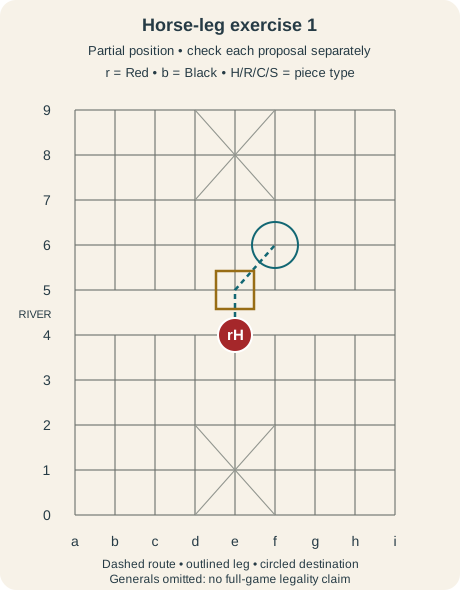
Case 1
Red proposes e4 to f6. Which intersection is the leg, and does the proposal pass the local horse-move conditions?
Show answer and explanation for case 1
The leg is e5. The proposal passes the local piece-move check.
From e4, the longer displacement is two ranks upward; the first orthogonal intersection is e5. It is empty, and the final diagonal step reaches f6. The destination is on the board and empty. Do not inspect f5 as the leg: that intersection is diagonally adjacent to the starting horse. No general-safety conclusion follows from this partial board.
Exercise 2: Your own soldier can block your horse
Position: e4 rH, e5 rS. Other intersections are empty for this local exercise. Proposal: e4 to f6.
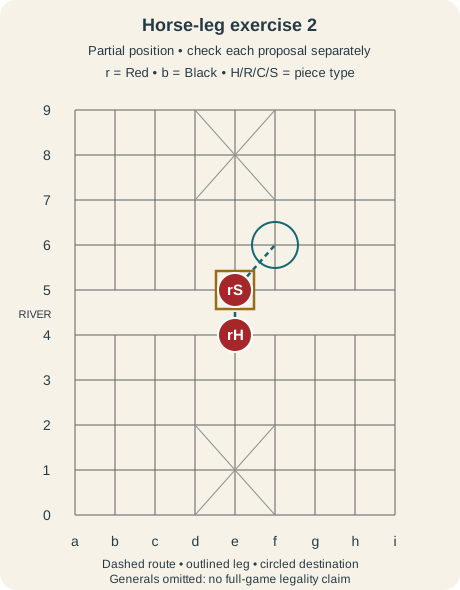
Case 2
Red proposes e4 to f6 with a red soldier on e5. Can the horse pass over its own soldier?
Show answer and explanation for case 2
No. The red soldier on e5 blocks the leg.
The destination f6 is empty, but that is only one condition. The leg e5 must also be empty. A friendly piece blocks a horse just as an opposing piece does. You cannot jump over the soldier or capture your own soldier to complete this move. Changing the soldier position would create a new position that must be checked separately.
Exercise 3: An enemy on the leg is a blocker, not a capture
Position: e4 rH, f4 bS. Other intersections are empty for this local exercise. Proposal: e4 to g5.
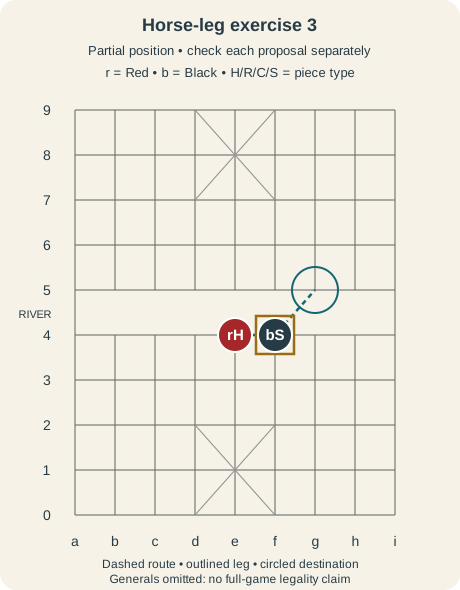
Case 3
Red proposes e4 to g5. A black soldier occupies f4. Can the horse capture that soldier while continuing to g5?
Show answer and explanation for case 3
No. The black soldier on f4 blocks the leg.
The long displacement is two files right, so f4 is the leg. A horse captures, when allowed, at its destination; it does not capture a piece halfway through the route. The soldier is not on g5. A different red piece might remove the blocker in a real game, but neither that move nor the resulting general safety is established here.
Exercise 4: A nearby diagonal piece is not this move’s leg
Position: e4 rH, f5 bS. Other intersections are empty for this local exercise. Proposal: e4 to g3.
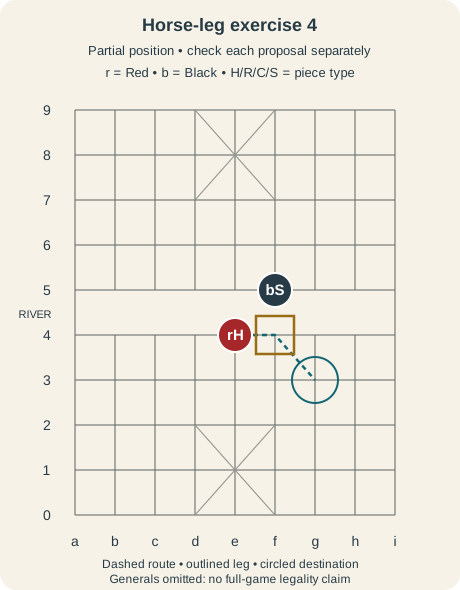
Case 4
Red proposes e4 to g3. A black soldier stands on f5, while f4 and g3 are empty. Does f5 block this proposal?
Show answer and explanation for case 4
No. This proposal uses f4, and it passes the local piece-move check.
The move goes one orthogonal intersection right to f4, then diagonally down-right to g3. The soldier at f5 is diagonally adjacent to e4; it is not the first step for this route. A piece being close to a horse is not enough to block every move. Identify the leg of the particular destination before deciding.
Exercise 5: An empty leg does not permit a friendly destination
Position: e4 rH, f6 rR. Other intersections are empty for this local exercise. Proposal: e4 to f6.
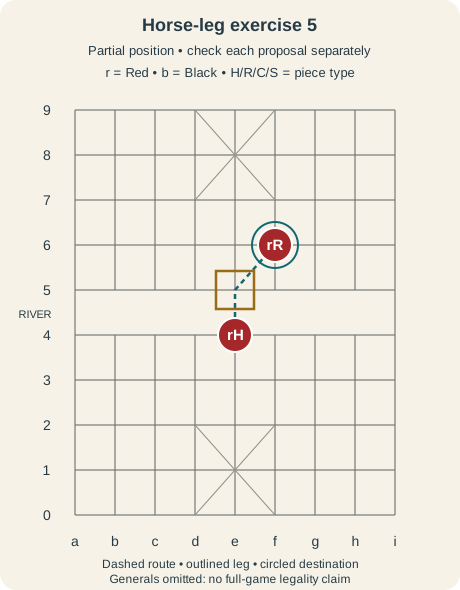
Case 5
Red proposes e4 to f6. The leg e5 is empty, but a red chariot occupies f6. Is an empty leg sufficient?
Show answer and explanation for case 5
No. Red cannot land on the red chariot at f6.
The geometry and leg check pass, but the destination belongs to a friendly piece. Horses do not stack with another piece or capture their own side. Record this as a destination-occupancy failure rather than a blocked leg. Keeping those two reasons separate makes it easier to see what would need to change in a later position.
Exercise 6: An enemy at the destination can be captured locally
Position: e4 rH, g5 bC. Other intersections are empty for this local exercise. Proposal: e4 to g5.
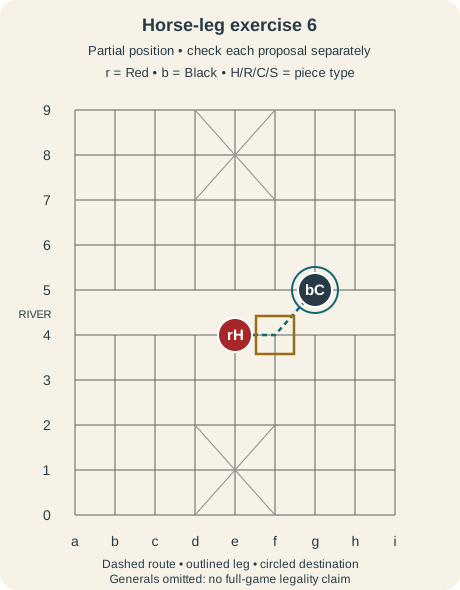
Case 6
Red proposes e4 to g5, where a black cannon stands. The leg f4 is empty. What happens under the local piece-move conditions?
Show answer and explanation for case 6
The local conditions permit Red to capture the black cannon on g5.
The horse uses f4 as its empty leg and lands on an opposing piece at g5. The cannon is removed only as the destination capture; the horse does not need a cannon-style screen. This answer does not show that the capture is safe, wins material overall or is legal under check. Those questions need the omitted pieces and generals.
Exercise 7: One occupied leg blocks two destinations
Position: e4 rH, f4 bS, b0 rR. Other intersections are empty for this local exercise. Proposal: A: e4 to g5; B: e4 to g3; C: e4 to d6; D: e4 to f6.
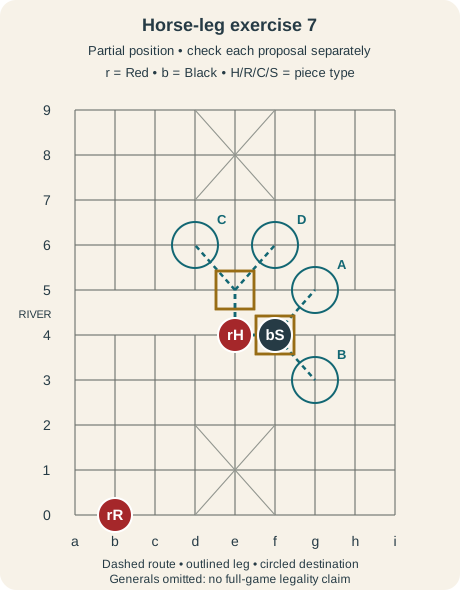
Case 7
From this same initial board, check four separate proposals: A e4 to g5; B e4 to g3; C e4 to d6; D e4 to f6. Which two share a blocked leg?
Show answer and explanation for case 7
A and B are blocked by f4. C and D pass the local check through empty e5.
Both rightward destinations use the first step e4 to f4, so one black soldier removes both routes. The upward pair uses e5 instead; the chariot at b0 occupies none of these legs or destinations. These are four alternatives from one unchanged position, not four moves played in succession. A leg block is directional: it does not automatically immobilise the horse or block every L-shaped destination.
Exercise 8: The board edge removes destinations before leg checks
Position: a0 rH, b0 rR. Other intersections are empty for this local exercise. Proposal: A: a0 to b2; B: a0 to c1.
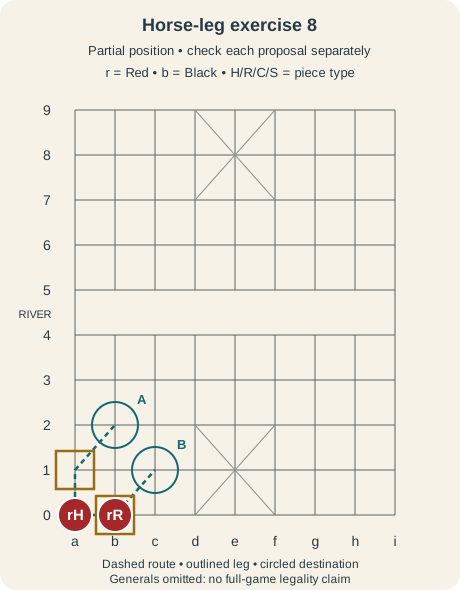
Case 8
Red’s horse is at the bottom-left corner a0. Which destinations are geometrically on the board, and which passes the local check with a red chariot at b0?
Show answer and explanation for case 8
Only b2 and c1 are on-board horse destinations. Only b2 passes here.
The other six L-shaped displacements leave files a–i or ranks 0–9 and are rejected at the board boundary. The route to b2 uses empty a1. The route to c1 uses occupied b0 and is blocked. Neither moving off the board nor wrapping around its edge is permitted. This is a partial position after pieces have moved, not an initial setup diagram.
Exercise 9: A horse may cross the river without changing its rule
Position: e4 rH, d5 bS, e3 rS. Other intersections are empty for this local exercise. Proposal: e4 to d6.
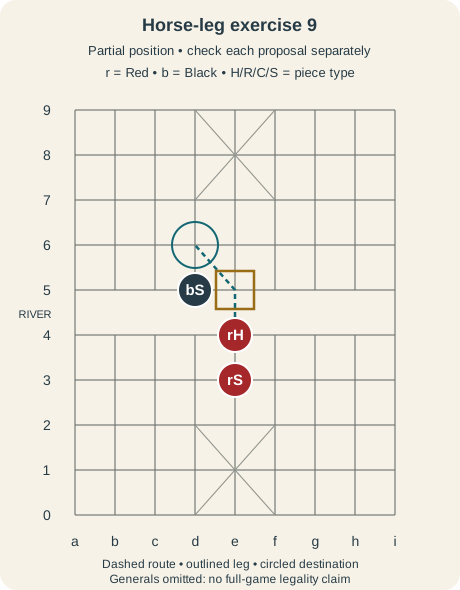
Case 9
Red proposes e4 to d6 across the river between ranks 4 and 5. The black soldier is on d5, not e5. Does the river or soldier prevent this proposal?
Show answer and explanation for case 9
No. The horse can cross the river; empty e5 permits this local route.
The first orthogonal step is from e4 to e5; the final diagonal step reaches d6. Neither d5 nor e3 is the leg for this destination. The horse has no elephant-style river restriction, and crossing does not give it new movement powers. It still needs an empty leg and an available on-board destination on either side of the river.
Exercise 10: Horse attacks need not be reciprocal
Position: e4 rH, f6 bH, f5 bS. Other intersections are empty for this local exercise. Proposal: A: e4 to f6; B: f6 to e4.
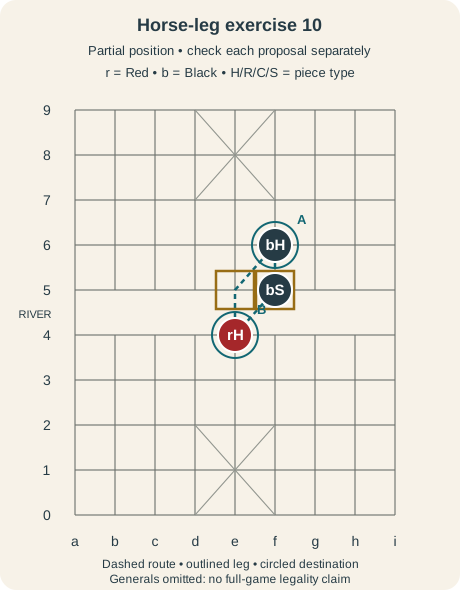
Case 10
Use the initial diagram for two independent proposals. A: Red e4 captures Black f6. B: Black f6 captures Red e4. Which local routes pass with a black soldier on f5 and e5 empty?
Show answer and explanation for case 10
A passes through e5. B is blocked at f5. The two horse routes are not reciprocal here.
For Red, the two-rank upward component makes e5 the leg. For Black, the two-rank downward component makes f5 the leg. Those are different intersections. The black soldier blocks Black’s route but not Red’s route. Do not play A and then ask B: A would have removed the black horse. These are alternatives in the same original partial position, and neither answer evaluates a pin or check.
Reuse the check without losing the full-position boundary
| Mistake | Correction | Next check |
|---|---|---|
| “The L shape is enough.” | Identify its first orthogonal leg. | Is that intersection empty? |
| “Only enemy pieces block.” | Either side can occupy and block the leg. | Record which coordinate is occupied. |
| “The leg blocker is capturable.” | A horse captures at its destination. | Is the enemy actually at the landing point? |
| “One block stops all eight moves.” | One leg normally serves a pair of destinations. | Check the other three legs and board edges. |
| “The two horses attack each other.” | Their reverse routes may use different legs. | Check both routes from the same initial board. |
| “A local capture is safe and legal.” | Omitted generals and attacks remain unknown. | Use a complete position for check and tactical review. |
A correct explanation distinguishes the reason a proposal fails. “Blocked at e5” and “friendly piece on f6” point to different changes. After a blocker is removed or a horse moves, recompute the new leg rather than carrying the old answer forward. In a full game, also respect whose turn it is and whether the proposed move leaves that side’s general threatened.
For actual play, reconstruct all occupied intersections and both generals before analysing check, pins, facing generals or a tactical continuation. For competition questions about repetition, chase or time controls, use the rules adopted by the event. This worksheet addresses ordinary horse movement and does not claim that a particular platform’s tournament procedures apply everywhere.
HORSE-LEG CHECK RECORD — PARTIAL POSITION
Fixed view: files a–i left to right; ranks 0–9 bottom to top.
Position ID / exact listed pieces and coordinates:
Proposal from / to (use the unchanged initial position each time):
Destination on board? / displacement 2+1?
Leg coordinate / empty, friendly piece or enemy piece:
Destination empty, friendly piece or enemy piece:
Local movement result / exact reason:
Full position and general-safety information still needed:
Later position after an actual move / checks repeated:
Do not label a local pass as full-game legality or a tactical win.
Download all ten positions, questions, explanations and the blank check record. The SVG files can be printed or placed beside a physical board. Use the page’s questions-only print button for a first pass and its answers print button for review.
If you mistake a diagonal neighbour for the leg, redo exercises 1, 4 and 9. If you confuse blockers with captures, compare exercises 3, 5 and 6. For move availability and nonreciprocal routes, return to exercises 7, 8 and 10 and identify each leg before opening the answer.
Sources and further reading
- Xiangqi.com: Learning the Xiangqi Pieces and MovesHorse movement, leg blocking and river crossing, with text and an explanatory diagram. Used for these local movement exercises; not a complete-position or competition assessment.
- Xiangqi.com: How to Start a Chinese Chess GameNine files, ten ranks and placement on intersections. This worksheet defines its own fixed coordinates; platform-specific timing and repetition procedures are outside its scope.