Practical guide
How to Read a Go Ladder and Check a Ladder Breaker
Read every move on the full board and count the threatened string’s liberties. A ladder can run to an edge capture, while an outside support stone can stop the same succession of ataris. That changed count is not a proof of permanent life.
Count the whole path, not just the first atari
A ladder is a capture sequence to read one position at a time. In the displayed line, each Black attack leaves the threatened White string with one liberty; White’s extensions drive it along a staircase until the board edge permits capture. The pattern alone is not proof: an outside stone can change the later connections.
The BGA puzzle sheets ask whether ladders work on complete boards, and its terminology list describes a ladder breaker as a stone in a potential ladder’s path that threatens to make it fail. Here we use original boards and checked finite branches. We do not claim an engine’s best play, every possible defence or the strongest move in a real game.
Start from the complete four-stone 9×9 position
Files A–I include I, and ranks 1–9 increase from the bottom. Black occupies B3, B4 and C2; White occupies C3. Every other point is empty. Black is next. The White C3 string begins with two liberties, C4 and D3.
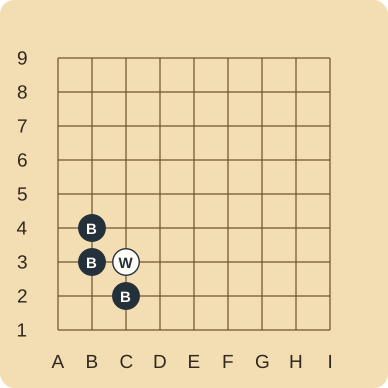
This is a composed teaching setup. The first three Black stones are initial occupancy, not an asserted history of unopposed Black turns. We use orthogonal strings, captures before the no-self-capture check, and the immediate-ko convention in the BGA introduction. The displayed line makes no repeated board.
Read the first two attack-and-extension pairs
- Black D3. White C3 has only C4 left.
- White C4. The C3/C4 string now has C5 and D4.
- Black C5. Only D4 remains.
- White D4. The enlarged White string now has D5 and E4.
The Black B4 stone is part of what makes this path narrow. It removes an extra western liberty when White extends at C4. In every step, count the complete growing White string, including liberties beside older stones. Do not count only the newly placed stone.
The recorded White continuations extend at the shown last liberty to preserve the string for the next position. Other legal moves elsewhere might sacrifice it or change a wider position. This lesson checks the displayed line; it does not label every move in a real game forced.
Follow every displayed move to the edge
| Ply | Placement | White string liberties after this move | Stones captured |
|---|---|---|---|
| 1 | Black D3 | C4 | 0 |
| 2 | White C4 | C5 D4 | 0 |
| 3 | Black C5 | D4 | 0 |
| 4 | White D4 | D5 E4 | 0 |
| 5 | Black E4 | D5 | 0 |
| 6 | White D5 | D6 E5 | 0 |
| 7 | Black D6 | E5 | 0 |
| 8 | White E5 | E6 F5 | 0 |
| 9 | Black F5 | E6 | 0 |
| 10 | White E6 | E7 F6 | 0 |
| 11 | Black E7 | F6 | 0 |
| 12 | White F6 | F7 G6 | 0 |
| 13 | Black G6 | F7 | 0 |
| 14 | White F7 | F8 G7 | 0 |
| 15 | Black F8 | G7 | 0 |
| 16 | White G7 | G8 H7 | 0 |
| 17 | Black H7 | G8 | 0 |
| 18 | White G8 | G9 H8 | 0 |
| 19 | Black G9 | H8 | 0 |
| 20 | White H8 | H9 I8 | 0 |
| 21 | Black I8 | H9 | 0 |
| 22 | White H9 | I9 | 0 |
| 23 | Black I9 | White string removed | 12 |
No capture occurs before the last row. After White H9, the growing White string has only I9 left: the top board edge supplies no additional escape point. Black I9 occupies that last liberty and removes all twelve White stones, including the original C3.
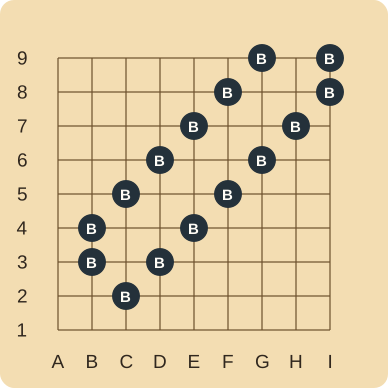
Download every complete state and capture record. The file lists Black, White and empty sets, side to move and each string’s liberties. Reset from the parent when reviewing; do not combine this endpoint with a different branch.
Now add an outside White F6 before starting
Use a separate complete parent: Black B3, B4 and C2; White C3 and F6; all other points empty; Black next. F6 is a pre-existing support stone, not a White move added midway through the earlier line.
Replay the same first ten placements through White E6. That extension connects the growing White string to F6. The connected string now has three liberties: E7, F7 and G6. In the original parent without support, the corresponding string had only E7 and F6.
Try the same next Black attack, E7. In the support version, White retains F7 and G6: two liberties. E7 is therefore not atari on this complete White string. The earlier successive-atari explanation stops at this point.
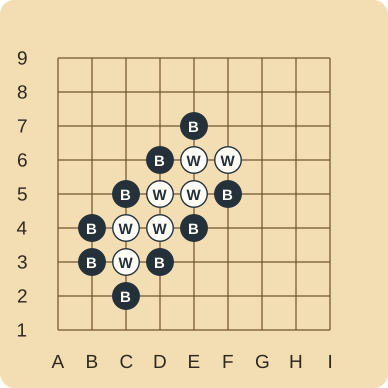
Do not blindly continue with the old next White move F6; that intersection was occupied from the beginning of this variation. Find a fresh candidate on the actual board. Two current liberties are not two eyes, and stopping this displayed ladder does not prove permanent life.
Download the complete support comparison. It ends after the tested Black E7; no unverified continuation is supplied.
Use a ladder reading card on another complete board
| Check | What to write |
|---|---|
| Parent | Size, key, complete stones, side to move and relevant rule history. |
| Threatened string | Its full stone list and distinct liberties before the first attack. |
| Each move | Candidate, captured stones and resulting full-string liberties. |
| Outside support | Any stone that will connect or change a later liberty; include it before replay. |
| Endpoint | Exact capture, loss of atari, unresolved defence or another tested stopping condition. |
For a crop from a larger game, inspect the whole route before using the staircase picture as an answer. A remote stone, board edge or different initial connection can change the count. Keep the strategic conclusion as narrow as the checked evidence.
Use responding to atari for the first extension, connection or countercapture choice. Use weak groups and escape routes to distinguish preventing an immediate capture from reaching permanent safety.
Sources and further reading
- British Go Association: placement, liberties and capture rulesThe complete introduction supports the local placement, capture, no-self-capture and immediate-ko conventions used to verify each displayed move.
- BGA Go Puzzle Sheet 7.4: ladders and netsThe retrieved complete ASCII sheet supplies real educational ladder questions on full boards. Its puzzles are not copied here; the positions and move checks are original.
- BGA Japanese Go terminology: Shicho and Shicho-atariThe relevant definitions name ladder play and a ladder breaker as a stone in a potential ladder path that threatens to make it fail.