Practice worksheet
Xiangqi Cannon Screens: 10 Capture Practice Positions
Count the exact screens, distinguish captures from quiet moves, and check ten original complete teaching positions. Includes answer boards, an optional checker, facing generals, and a legal reply to check.
A cannon needs one screen to capture, and none to move quietly
A Xiangqi cannon captures an enemy piece on the same file or rank by jumping exactly one intervening piece. For a move to an empty intersection, its route must be completely clear. That difference answers most beginner cannon questions: the rule for an enemy destination is different from the rule for an empty destination.
The intervening piece is the screen. Either side can supply it, and it can be another cannon. The capturing cannon lands on the enemy destination; it does not remove the screen. Count occupied intersections strictly between the starting point and destination. Neither endpoint counts as a screen.
These ten original practice positions let you change one condition at a time. Compare one screen with two, remove the only screen, change the screen’s colour, and replace an enemy destination with a friendly piece or an empty point. The last two problems add general safety and the difference between check and checkmate.
Each sparse teaching position lists every piece, including both generals; all unlisted intersections are empty. Red moves first in each question. These are composed exercises, separate from a historical game or opening score. They demonstrate ordinary piece movement and general safety on the shown board. They do not establish how the position was reached, assess a repetition history or certify a winning tactical choice.
Read the coordinates and the complete piece list
Use the same fixed Red-side view as our horse-leg worksheet: files a–i run left to right and ranks 0–9 run bottom to top. Red’s back rank is 0; Black’s is 9. The river is between ranks 4 and 5. Pieces stand on line intersections, not inside squares.
This is a worksheet coordinate system, separate from player-relative piece-file notation such as C8=5. Do not treat b2 as an advance or retreat score. The labels r and b mean Red and Black; G is general, C cannon, H horse and R chariot. Written labels accompany the colours so that a piece’s side is clear in print.
A dashed teal line is a proposed move, not a completed move or a legality signal. Before diagrams retain the original position. After diagrams appear inside the answers only for allowed moves. For a rejected proposal, keep the original pieces where they are and explain the failed condition.
Both generals start inside their own three-by-three palaces. Most exercises put Red’s general on e0 and Black’s on f9. Exercise 9 deliberately puts them on the same e-file, with the red cannon between them. Check that full piece list before deciding whether the cannon can leave.
Use five checks in order
| Check | What to inspect | What permits the move |
|---|---|---|
| Board and line | The exact source and destination. | Both on the board, on the same file or rank, and different intersections. |
| Destination | Empty, friendly or enemy? | A friendly destination is unavailable. |
| Screen count | Occupied points strictly between the endpoints. | Zero for an empty destination; exactly one for an enemy capture. |
| Resulting board | Where each piece would be after the move. | The cannon changes position; a captured destination disappears; the screen stays. |
| General safety | Enemy attacks on your general after the move. | Your general is safe, including the facing-generals rule. |
Write the occupied intermediate coordinates, rather than estimating the distance. A long line with one screen can permit a capture; a short line with two screens cannot. Empty intersections do not add to the count. A piece beyond the destination is not a screen for this capture, though it may matter for the resulting check.
The cannon can cross the river. Crossing does not turn it into a different piece or remove its screen requirement. Like any move, a capture must also leave your own general safe. Passing the screen test is therefore a necessary condition, rather than the whole decision.
Exercise 1: One friendly screen
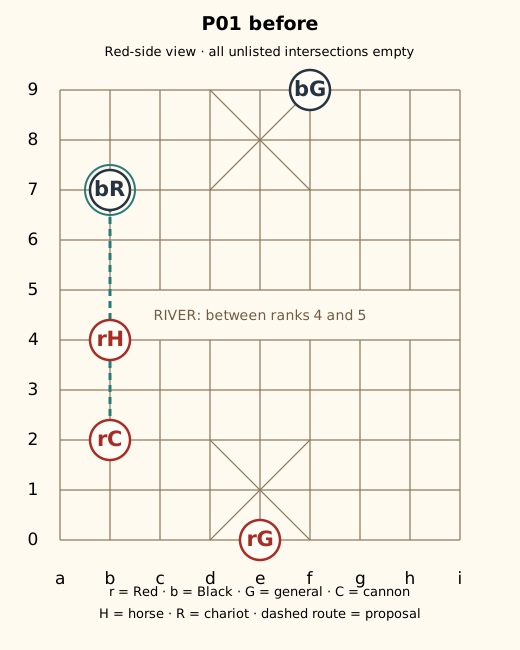
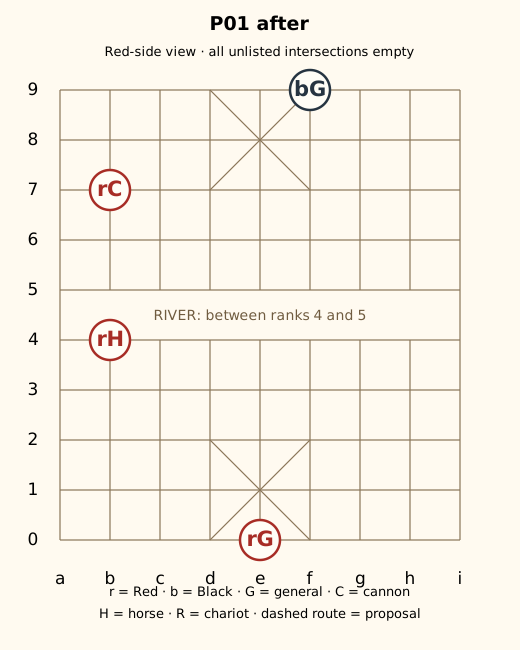
Complete position: e0 rG, f9 bG, b2 rC, b4 rH, b7 bR. All other intersections are empty. Red’s proposal: b2 to b7.
Case 1
Is Red’s proposal b2 to b7 allowed on this shown position? List any screens strictly between the endpoints, identify the destination type, and explain your decision.
Show answer and explanation for case 1
Yes. Red captures the black chariot on b7.
The occupied points strictly between b2 and b7 are b4 rH only. Red’s horse is a valid screen. Move the red cannon to b7 and remove the black chariot there; keep the red horse on b4. Red’s general on e0 is not exposed by the resulting position. There are fewer total pieces after a capture, but the screen itself survives.
Exercise 2: Adding a second screen
Complete position: e0 rG, f9 bG, b2 rC, b4 rH, b6 bC, b7 bR. All other intersections are empty. Red’s proposal: b2 to b7.
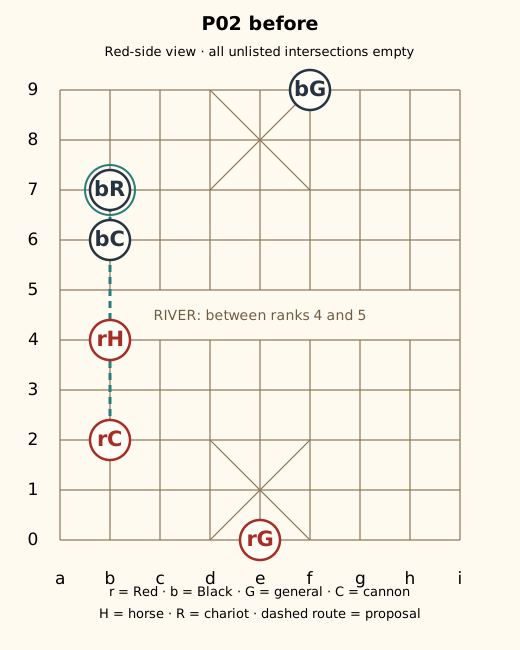
Compare this board with exercise 1: b6 bC has been added, while the source and enemy destination stay the same.
Case 2
Is Red’s proposal b2 to b7 allowed on this shown position? List any screens strictly between the endpoints, identify the destination type, and explain your decision.
Show answer and explanation for case 2
No. There are two screens: b4 and b6.
This starts from exercise 1’s arrangement and adds a black cannon at b6. Both b4 rH and b6 bC are strictly between b2 and b7. Their different colours do not cancel each other. A cannon capture needs exactly one screen, so leave the initial position unchanged. “At least one screen” is the wrong test.
Exercise 3: Removing the only screen
Complete position: e0 rG, f9 bG, b2 rC, b7 bR. All other intersections are empty. Red’s proposal: b2 to b7.
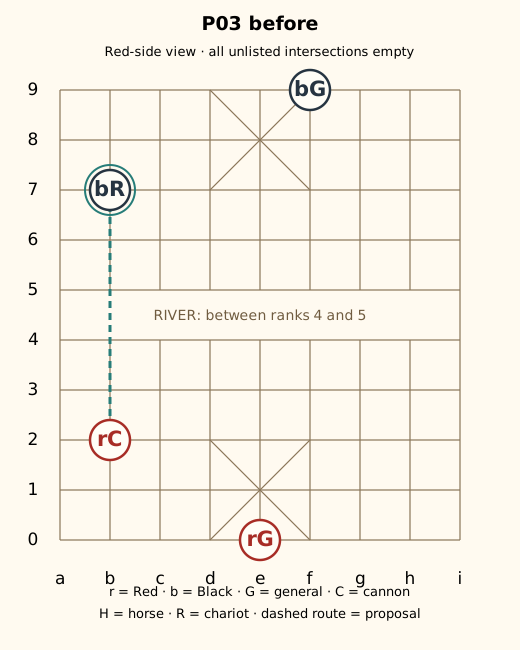
Compare with exercise 1 again: the horse on b4 has been removed, while the enemy destination remains occupied.
Case 3
Is Red’s proposal b2 to b7 allowed on this shown position? List any screens strictly between the endpoints, identify the destination type, and explain your decision.
Show answer and explanation for case 3
No. Zero screens cannot support this capture.
The destination b7 still contains a black chariot, but b3, b4, b5 and b6 are all empty. A cannon may move through an open line to an empty destination; it cannot use that ordinary movement to capture the enemy chariot. Removing a screen can therefore stop an attack instead of improving it. Keep both pieces on their original intersections.
Exercise 4: An enemy cannon can be the screen
Complete position: e0 rG, f9 bG, b2 rC, b4 bC, b7 bR. All other intersections are empty. Red’s proposal: b2 to b7.
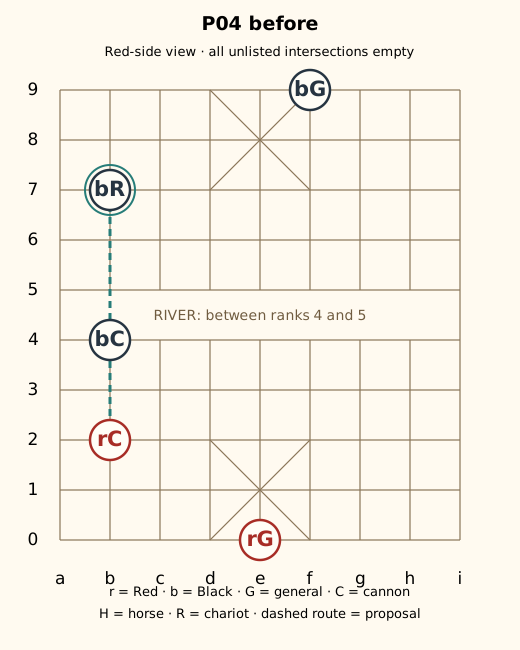
Case 4
Is Red’s proposal b2 to b7 allowed on this shown position? List any screens strictly between the endpoints, identify the destination type, and explain your decision.
Show answer and explanation for case 4
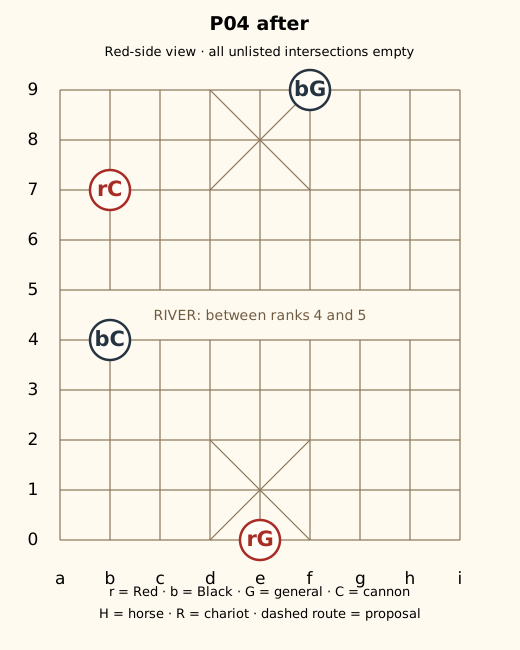
Yes. The black cannon on b4 is a valid screen and remains there.
There is exactly one intervening piece, b4 bC. A screen can belong to the opponent and can itself be a cannon. Red captures only the black chariot on b7. The enemy cannon on b4 is not removed as part of that capture; there is no chain capture. General safety also passes on this listed position.
Exercise 5: A friendly destination stays unavailable
Complete position: e0 rG, f9 bG, b2 rC, b4 rH, b7 rR. All other intersections are empty. Red’s proposal: b2 to b7.
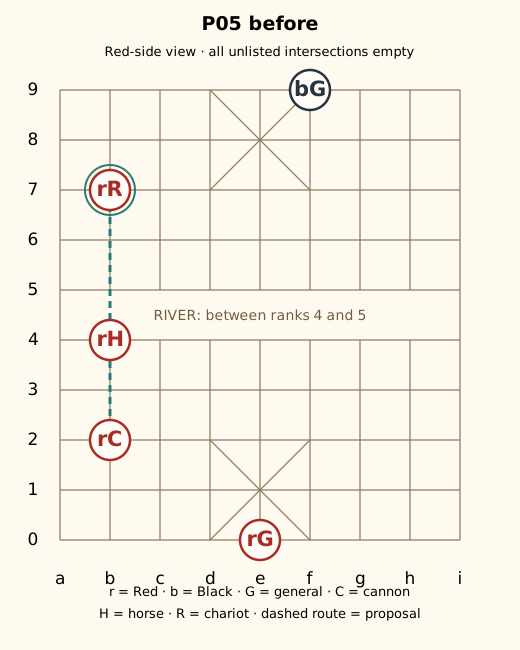
Case 5
Is Red’s proposal b2 to b7 allowed on this shown position? List any screens strictly between the endpoints, identify the destination type, and explain your decision.
Show answer and explanation for case 5
No. Red cannot land on the red chariot at b7.
There is one screen, b4 rH, but b7 contains a friendly destination piece. The screen rule does not allow a cannon to capture its own side, stack with another piece or push it elsewhere. Record this as a friendly-destination failure. It is different from an incorrect screen count, even though both prevent this proposal.
Exercise 6: One screen, but no piece to capture
Complete position: e0 rG, f9 bG, b2 rC, b4 rH. All other intersections are empty. Red’s proposal: b2 to b7.
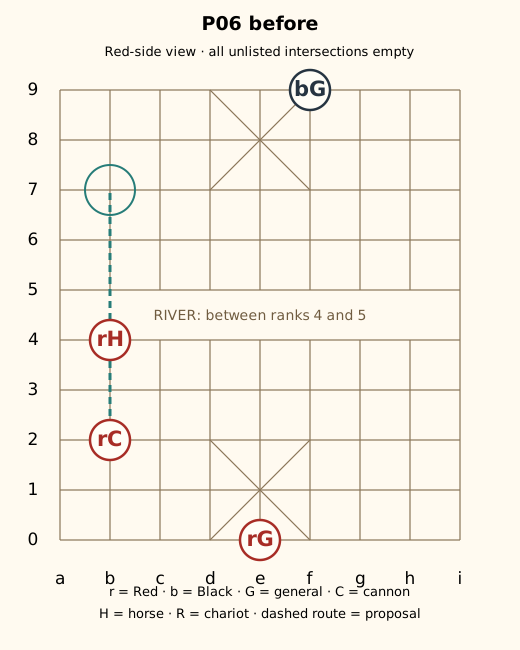
Case 6
Is Red’s proposal b2 to b7 allowed on this shown position? List any screens strictly between the endpoints, identify the destination type, and explain your decision.
Show answer and explanation for case 6
No. A cannon cannot jump a screen to an empty destination.
The only intervening piece is the red horse on b4, and b7 is empty. There is no enemy at the landing point to capture. An ordinary cannon move needs a clear route, so b4 blocks this move. Having exactly one screen does not make every landing beyond it available; first identify the destination type.
Exercise 7: An open ordinary move across the river
Complete position: e0 rG, f9 bG, b2 rC. All other intersections are empty. Red’s proposal: b2 to b5.
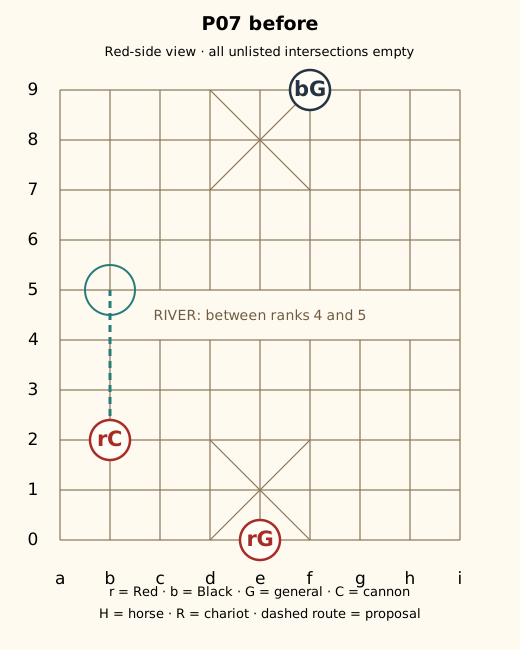
Case 7
Is Red’s proposal b2 to b5 allowed on this shown position? List any screens strictly between the endpoints, identify the destination type, and explain your decision.
Show answer and explanation for case 7
Yes. Red moves quietly from b2 to empty b5.
The intermediate intersections b3 and b4 are empty. The destination b5 is also empty, so this is a non-capturing move with zero screens. It crosses the river between ranks 4 and 5 without changing the cannon’s movement rule. Both generals remain safe and no piece is removed. Compare this with exercise 3’s open line to an occupied enemy destination.
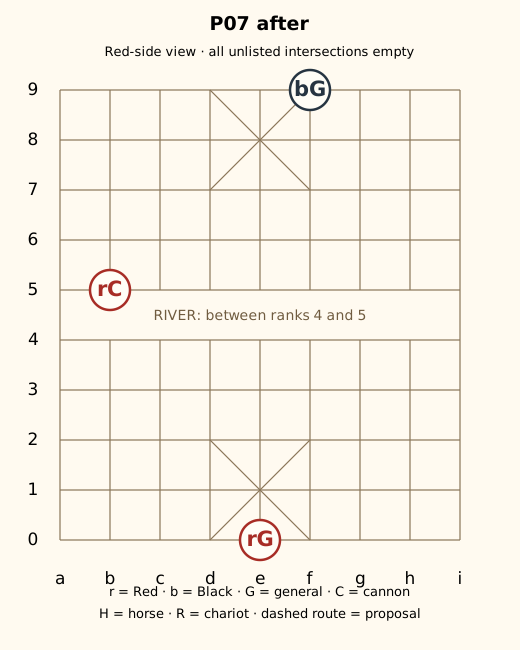
Exercise 8: A diagonal target does not make a cannon line
Complete position: e0 rG, f9 bG, b2 rC, b4 rH, c7 bR. All other intersections are empty. Red’s proposal: b2 to c7.
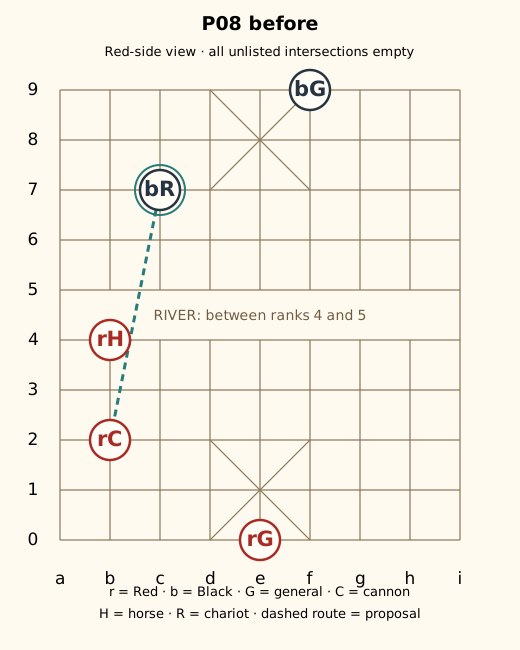
Case 8
Is Red’s proposal b2 to c7 allowed on this shown position? List any screens strictly between the endpoints, identify the destination type, and explain your decision.
Show answer and explanation for case 8
No. b2 to c7 is not an orthogonal cannon move.
The proposed destination differs in both file and rank. Do not trace a bent route or count the horse on b4 as if it established a diagonal jump. A cannon’s source, screen and captured destination must lie on one straight rank or file. The marked diagonal line is only the rejected proposal; leave all original pieces unchanged.
Exercise 9: A capture route that exposes facing generals
Complete position: e0 rG, e9 bG, e3 rC, c3 rH, a3 bR. All other intersections are empty. Red’s proposal: e3 to a3.
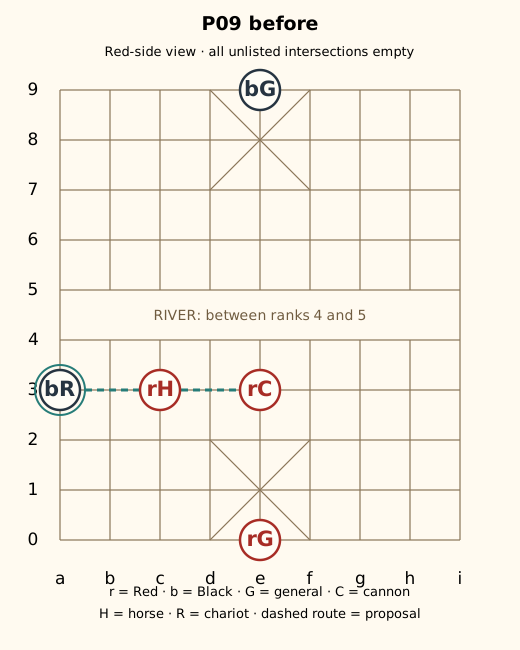
Case 9
Is Red’s proposal e3 to a3 allowed on this shown position? List any screens strictly between the endpoints, identify the destination type, and explain your decision.
Show answer and explanation for case 9
No. Moving the cannon exposes facing generals.
The horizontal route e3 to a3 has one screen, c3 rH, and an enemy chariot at a3. That passes the cannon capture geometry. But e3 is the only occupied intersection between Red’s general on e0 and Black’s general on e9. Moving the cannon away clears the e-file and leaves the two generals directly facing. Reject the move for general safety; do not label the diagram as a completed legal capture.
Exercise 10: A legal capture gives check, with a legal reply
Complete position: e0 rG, f9 bG, f2 rC, f4 rH, f7 bR, f8 bH. All other intersections are empty. Red’s proposal: f2 to f7.
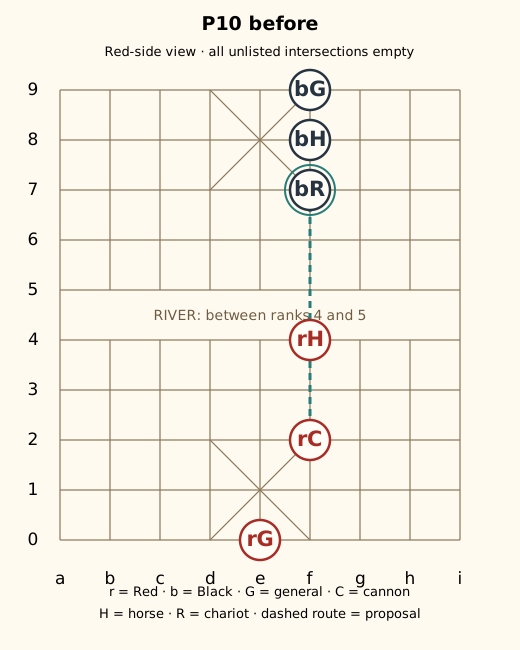
Case 10
Is Red’s proposal f2 to f7 allowed on this shown position? List any screens strictly between the endpoints, identify the destination type, and explain your decision.
Show answer and explanation for case 10
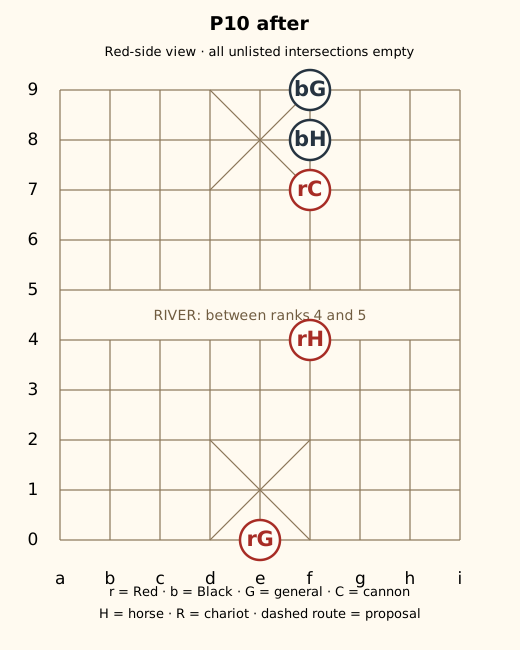
Yes. Red captures on f7 and gives check, but this is not checkmate.
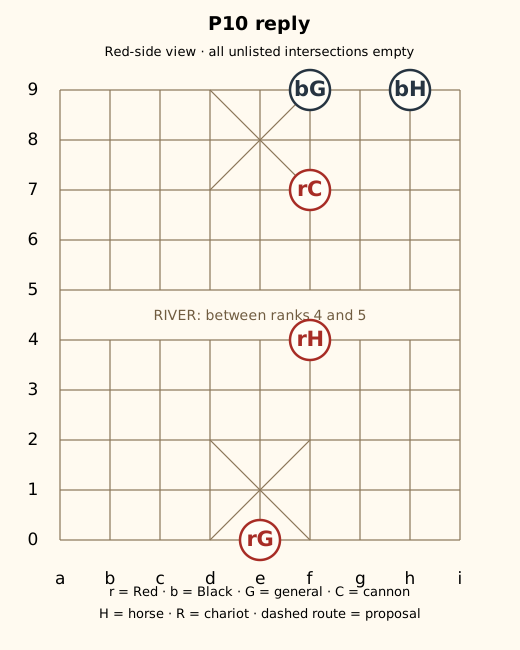
Between f2 and f7, the only screen is f4 rH. The black horse on f8 lies beyond the destination, so it does not count for this capture. After Red’s cannon lands on f7, that horse becomes the single screen between the cannon and Black’s general on f9: Black is in check. Black can reply with the horse f8 to h9 through the empty leg g8. Removing the f8 screen makes the f7-to-f9 line have zero screens; the general is no longer under that cannon attack. The reply stays on the board and leaves Black’s general safe.
Check an answer or compare the screen changes
Use this optional checker after trying a board question. It handles only the ten supplied positions and their four piece types. It is a lesson aid, separate from a general-purpose Xiangqi engine, an opening analyser or a competition adjudicator. The printed questions and explained answers above remain available without it.
If you answered exercise 2 or 3 incorrectly, compare the three screen buttons while keeping the enemy destination in mind. If you answered exercise 6 incorrectly, return to its empty landing point. If you missed exercise 9, add a separate general-safety line to your written move check rather than relying on the capture count.
Take the rule to a real board without guessing checkmate
| Mistake | Correction | Revisit |
|---|---|---|
| “More screens give more power.” | Exactly one screen permits a capture; two block it. | Exercises 1–3. |
| “Only my pieces can screen.” | Either side, including another cannon, can supply the screen. | Exercise 4. |
| “One screen means any landing is legal.” | Inspect whether the destination is enemy, friendly or empty. | Exercises 5–6. |
| “Removing a piece always opens an attack.” | A cannon may lose its required screen. | Exercises 3 and 10. |
| “The capture shape proves legality.” | Inspect your own general on the resulting board. | Exercise 9. |
| “Giving check means winning.” | Test legal replies before calling it checkmate. | Exercise 10. |
On a physical board, list the complete occupied intersections before analysing a move. After a proposed capture, remove only the enemy destination and relocate the cannon. Recount the screen for each new attack; the screen for the capture and the screen for a later check may be different pieces, as exercise 10 shows.
Check and checkmate describe different conditions. Finding an attack on the general establishes check. A checkmate claim also needs every legal response to fail. Here one explicitly checked horse reply is sufficient to show that exercise 10 is not mate. It does not prove that this reply is best by material or that Red’s earlier capture wins the game.
The World Xiangqi Rules, Article 2.6, uses “cannon mount” for the intervening piece; this guide uses the common teaching word “screen”. Articles 2.8–2.10 cover friendly destinations, facing generals and responses to check. Article 2.10.C explicitly includes moving a friendly cannon mount away to resolve a cannon check, as the horse reply in exercise 10 does. The linked pieces-and-moves and board guides provide another beginner explanation. For competition questions about repetition, pursuit or other event procedures, consult the rulebook adopted by your organiser; the federation’s publication page links the World Xiangqi Rules. Keep that event-specific work separate from this ten-position movement lesson.
Download the blank move-check record and the ten complete positions with written answers. Each board also has an SVG link. Use “Print questions only” for your first attempt and “Print with answers” when reviewing; answer diagrams stay with their solutions. For broader piece and board rules, continue to the Xiangqi rules hub.
Sources and further reading
- Xiangqi.com: Learning the Xiangqi Pieces and MovesCannon ordinary moves and exactly-one-screen captures; horse-leg blocking and the facing-generals boundary. Platform-specific timing or repetition procedures are outside this worksheet.
- Xiangqi.com: How to Start a Chinese Chess GameNine files, ten ranks and placement on intersections. The diagrams define their own fixed worksheet coordinates.
- World Xiangqi Federation: World Xiangqi Rules, Chapter 1The publication page links the English rulebook. Printed pages 4–5 (PDF pages 12–13), Articles 2.6 and 2.8–2.10, cover cannon mounts, destination occupancy, facing generals and resolving check. The original problems here are not federation-reviewed.