Practical guide
How to Check a False Eye in Go: Trace the Guarding Strings
A surrounded empty point is not enough. Trace its guarding strings and exterior liberties: a disconnected guard can be put in atari, and saving it inside the point fills the apparent eye. Check the full board before claiming group life.
Inspect the guarding strings before counting an eye
An empty point can look surrounded by your stones and still be a false eye. Check whether the surrounding stones form the same solid string and whether a separate guarding string can be put in atari. If preserving that string requires playing inside the apparent eye, that empty point cannot be counted as a reliable eye in the same way.
Sensei’s Library describes this incomplete-connection and exterior-liberty problem; the BGA terminology list also names the false eye. Here the explanation uses complete original 5×5 teaching boards and checked local moves. No source diagram is copied, and no game or professional evaluation is claimed.
A false eye is a warning about the shape, not a verdict that every group with one must die. Start with the actual strings and replies rather than counting visible holes.
First compare a genuine one-point eye
Use files A–E, ranks 1–5 from the bottom. Black occupies B2, C2, D2, B3, D3, B4, C4 and D4. White has no stones. Every other point is empty; White is next. The eight Black stones form one connected ring, and C3 is enclosed inside it.
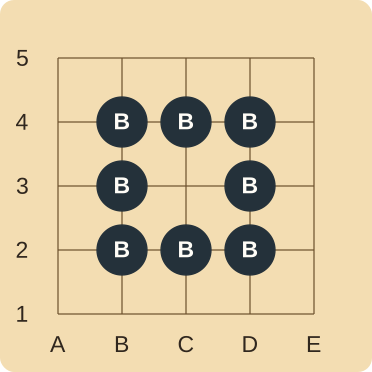
Trying White C3 captures nothing: the Black ring still has liberties outside C3. The new White stone has no liberty, so this move is rejected under the no-self-capture convention used here. The accepted board stays unchanged.
That proves this entry is prohibited in this position. It does not prove Black’s whole group is alive forever. A single genuine eye and two independent eyes are different claims; the existing complete two-eye comparison demonstrates the stronger case.
Now inspect the separate guarding string
Reset to a different complete board. Black: A3, B3, C2, D2, D3, D4, C4. White: A2, B2, B4. Every other point is empty; White next. C3 again has Black stones on all four orthogonal sides, but those guards are not all one string.
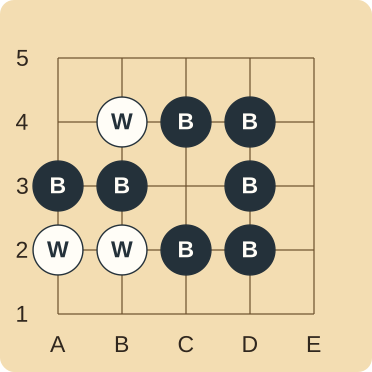
Black A3/B3 is one two-stone string. The other five Black stones form another string. The empty C3 lies between them; an empty point does not already join the guards. The A3/B3 string can be attacked through the exterior point A4.
White C3 is also rejected if tried immediately in this initial board: A3/B3 still has A4, so nothing is captured and the new White stone has no liberty. This is why a single immediate entry test does not establish that an apparent eye will remain reliable after exterior liberties change.
Exterior pressure can make the eye-filling connection relevant
From the false-eye parent, play White A4. The A3/B3 string now has only C3: it is in atari. The other guarding string still has liberties elsewhere.
One checked Black response is Black C3. It connects the guarding strings into one eight-stone string and captures nothing. A3/B3 is preserved, but C3 is now a Black stone rather than an empty eye point.
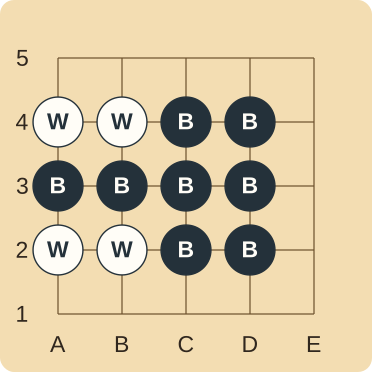
The result has outward liberties. It is not a proof of permanent life or a statement that C3 is Black’s only strategically worthwhile choice. The relevant local fact is that this connection and this supposed empty eye cannot both remain in the displayed result.
A separate ignore branch allows a capture entry
Reset again to the same false-eye parent. Replay White A4, Black E5, White C3. Black E5 is a legal unrelated placement; it does not protect A3/B3.
White C3 now takes the guarding string’s last liberty and captures both Black A3 and B3. Removing them makes B3 a liberty of the new White stone, so the C3 placement is accepted under the local capture-before-no-self-capture check.
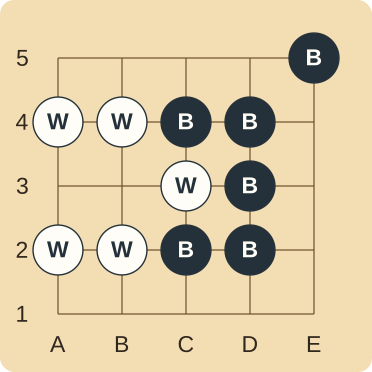
This branch establishes the exact two-stone capture. It does not assign a final score, prove all remaining Black stones dead or evaluate the value of E5. Those are further questions requiring their own position and continuations.
Keep three different eye claims separate
| Claim | Evidence | Limit |
|---|---|---|
| One genuine eye here | Connected eight-stone ring; initial White C3 rejected. | One eye alone is not group life. |
| False-eye warning here | Separate A3/B3 guard; W A4 creates atari; connecting at C3 fills the point. | Not a universal death verdict. |
| Entry after ignoring the guard | W A4 / B E5 / W C3 removes A3/B3 and leaves new White a liberty. | Finite local capture, not a finished game. |
Two adjoining empty points might also be one eyespace rather than two independent eyes. Use the weak-group lesson’s exact counterexample for that distinct mistake. A group may also survive through seki; eye counting alone is not a universal life test.
Use a reproducible eye check
- Write the complete board, coordinate key, side to move and rule convention.
- Trace every guarding stone into its solid string; do not silently connect diagonal or separated stones.
- List each guard string’s distinct liberties, including exterior points.
- Test a specific exterior attack and a specific response, removing captures before counting again.
- State whether the result preserves an empty eye, fills it, loses a guard, or remains unresolved.
Download the complete states and rejected-entry records. The file distinguishes the real-eye test from both false-eye branches. Keep those separate boards when replaying.
Practice: Why is White C3 initially rejected in both parent boards, while the second position is still a false-eye example? In the second board the disconnected guard has an exterior liberty that White can remove. The later accepted C3 capture is about that changed complete position, not a changed self-capture rule.
Sources and further reading
- BGA: strings, captures and no-self-captureComplete relevant introduction read 5 November 2026; the local convention governs every original displayed move.
- Sensei’s Library: False EyeCurrent full text read 5 November 2026, page last edited 12 August 2026. Used for the incomplete-connection/exterior-atari definition, not source-diagram coordinates.
- BGA Go terminology: false eyeRelevant false-eye naming entry read; diagrams and complete branches are original.