Practical guide
What Is Seki in Go? A Complete Board Explains Mutual Life
Seki is a stand-off in which opposing strings survive together because trying to start the capture allows the opponent to capture first. A string can therefore be alive without two eyes. The shared empty point is only a clue: count the whole strings and test the actual replies.
Mutual life is a tested result, not an empty-point pattern
The British Go Association calls seki a local stand-off caused by a shortage of liberties. Neither opposing string has two eyes, yet neither side can start a successful capture against a correct reply. This is different from two genuine separate eyes, which protect a string from an opponent’s ordinary attempt to fill its liberties under the stated no-self-capture rule.
“Neither can capture” does not mean that captures become illegal forever. If a player fills the wrong point, a capture can become legal immediately. The point is that starting the fight loses the starting player’s string in the position below.
Read liberties and captures first if you are unsure how to identify a connected string. A liberty is an empty orthogonal neighbour of the complete string. Count a point once even when it touches several stones.
Set up this complete five-by-five teaching board
This is an original composed 5×5 teaching board, not an extract from a larger board or a claimed played game. Its deliberately crowded position isolates the mechanism. The actual edges matter: there are no omitted outside stones or escape routes.
Files A–E run left to right; ranks 1–5 run from the bottom. B marks Black and W marks White. There are 25 intersections: 11 Black stones, 11 White stones and three empty points. Test Black to move and White to move separately, resetting the board between trials.
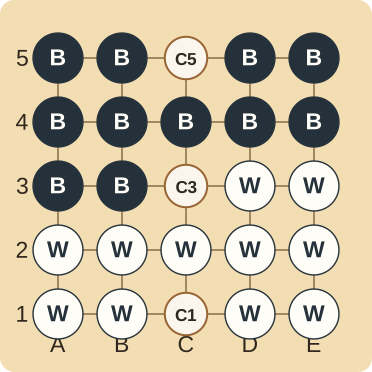
| Colour | Occupied intersections |
|---|---|
| Black | A5 B5 D5 E5; A4 B4 C4 D4 E4; A3 B3 |
| White | D3 E3; A2 B2 C2 D2 E2; A1 B1 D1 E1 |
| Empty | C5 C3 C1. Every other intersection is occupied as listed. |
Black’s stones form one solid string. White’s stones form one solid string. C5 is Black’s single eye at the top edge: its three on-board neighbours are Black. C1 is White’s corresponding eye at the bottom edge. The board edge supplies no additional liberty. C3 touches both colours and is shared.
Write the two liberty sets before choosing a move
| String | Distinct liberties | What the points do |
|---|---|---|
| Black, 11 stones | {C3, C5} | C3 is shared; C5 is Black’s eye. |
| White, 11 stones | {C1, C3} | C3 is shared; C1 is White’s eye. |
Neither string has two eyes. Nevertheless, neither is in atari: each has two liberties. A player cannot initially enter the opponent’s eye. For example, White C5 would not remove Black, because Black still has C3. The new White stone would then have no liberties, so it is prohibited self-capture in this lesson’s rule model. Black C1 is rejected for the same reason.
Use the BGA introduction’s local placement convention here: play on an empty point, remove opposing strings with no liberties, then reject a placement that leaves the new own string with no liberties. The displayed branches do not create an immediate repeated board. They do not implement every possible repetition or scoring rule.
Black C3 lets White capture at C5
- Black plays C3. No capture occurs. Black’s enlarged 12-stone string has only C5 left. White’s original 11-stone string has only C1 left.
- White plays C5. This occupies Black’s final liberty, so all 12 Black stones are removed. Only after that removal do we check the new White stone’s liberties.
The move at C5 is now legal. The captured points B5, D5 and C4 are empty neighbours of the new White C5 stone. Its three liberties are {B5, C4, D5}. The original White string also gains liberties where Black used to stand; it is not captured in this sequence.
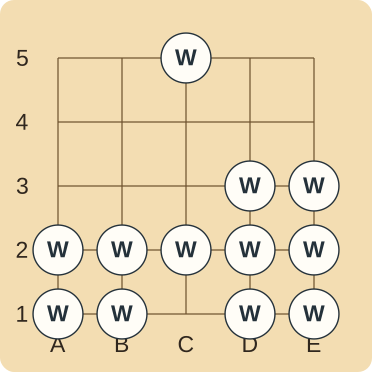
Before Black C3, entering C5 was self-capture for White. After Black C3, the same point is a legal capturing move. The changed liberty count, rather than the point’s appearance, explains the result.
Reset: White C3 lets Black capture at C1
Return to the initial board. Do not add this variation to the previous result.
- White plays C3. No capture occurs. White’s enlarged 12-stone string has only C1 left. Black’s original string has only C5 left.
- Black plays C1. Black occupies White’s last liberty and removes all 12 White stones.
The resulting board contains Black at its original 11 intersections and at C1; every other point is empty. The new Black C1 stone has three liberties, {B1, C2, D1}. This is the colour-reversed mechanism, checked from the same complete starting board.
Filling your own eye does not solve the problem either. Black C5 leaves the Black string with only C3, so White C3 captures it. White C1 likewise allows Black C3 to capture. The following table covers every initially empty point for both players.
| Player and point | Initial acceptance | Reply or reason |
|---|---|---|
| Black C3 | Legal; no capture | White C5 captures the 12-stone Black string. |
| Black C5 | Legal; no capture | White C3 captures the 12-stone Black string. |
| Black C1 | Rejected | No White capture; the new Black stone has no liberties. |
| White C3 | Legal; no capture | Black C1 captures the 12-stone White string. |
| White C1 | Legal; no capture | Black C3 captures the 12-stone White string. |
| White C5 | Rejected | No Black capture; the new White stone has no liberties. |
Passing leaves the board intact. Thus, in this isolated complete position, neither player has a placement that captures immediately or avoids the shown immediate loss against the capturing reply. This establishes the mutual-life mechanism here; it does not prove every shape called seki has exactly the same liberties.
A shared liberty alone does not prove seki
Now change one fact: C5 already contains a Black stone. This is a separate composed starting position, with White to move. Black has 12 stones, White has 11, and only C1 and C3 are empty.
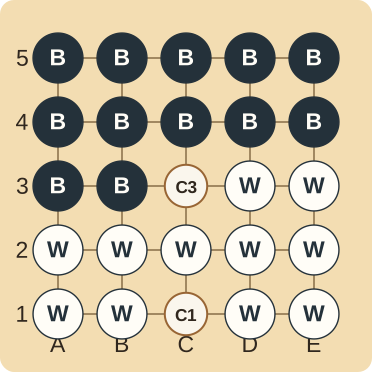
C3 still touches both colours, but the strings’ liberties are no longer balanced: Black has {C3}, while White has {C1, C3}. White can play C3 at once, capture all 12 Black stones and remain on the board. No preliminary losing White move is needed.
If you instead test Black C3 in this altered position, it captures nothing and leaves the Black string with no liberties, so it is rejected as self-capture under the stated convention. The shared-point label did not save Black. The complete liberty sets decided the result.
Check the mechanism without memorising the drawing
Cover the reply column above. On a physical board or a complete coordinate record, choose one player and one initial empty point. Say which strings change before naming a move “safe.”
Case 1
In the original position, why is White C5 illegal before Black C3 but legal immediately after it?
Show answer and explanation for case 1
Before Black C3, Black has another liberty. After Black C3, C5 is Black’s final liberty.
Initially White C5 captures nothing and has no liberties. After Black C3, White C5 removes all twelve Black stones first, creating B5, C4 and D5 as liberties for the new White stone.
Case 2
Does an opposing string with only one eye have to be removed as dead?
Show answer and explanation for case 2
No. The original strings survive through mutual life; the altered Black string can be captured.
A one-eye label is insufficient. In the original board, every legal initiating placement permits an immediate capture by the other player. In the altered board, White can capture Black immediately at C3.
Use a short seki reading card on your next problem
| Record | Your check |
|---|---|
| Position | Board size, coordinate key, complete stones and side to move: ____________________ |
| Strings | List the connected stones being compared: ____________________ |
| Liberties | Write each distinct liberty set; separate shared points from eyes: ____________________ |
| Candidate | Place one legal candidate; remove captures; count again: ____________________ |
| Reply | Show the opponent’s actual legal reply and every captured stone: ____________________ |
| Limits | Outside connections, missing history or unresolved scoring procedure: ____________________ |
For a crop from a real game, outside liberties, connections and other strings can change the answer. A local screenshot may leave them out. Keep the full board and relevant move history before extending a local result into a whole-game claim.
Life status and scoring are separate checks. Do not remove the original mutually living strings simply because neither has two eyes, and do not assign the shared point—or an eye—a universal score from this article. Use your adopted rules for ending play, disputes and counting. The examples demonstrate captures and mutual life, not a final score.
Continue with weak groups and escape routes when an extra outside liberty changes the position. If your question is accepting a placement rather than choosing it, use capture-before-self-capture checks.
Sources and further reading
- British Go Association: How to PlayRead 5 November 2026; the page displays a 26 October 2017 update. Supports orthogonal strings, liberties, capture-before-self-capture, eyes and the described seki stand-off. The complete boards and finite branches here are original teaching material, separately checked under those local conventions.
Check eye shape through the actual guarding strings
Compare complete real-eye and false-eye positions, including an exterior attack and the exact changed capture.