Practical guide
What Is Snapback in Go, and How Is It Different from Ko?
In this snapback, a one-stone capture leaves the capturing two-stone string in atari. The immediate reply takes both stones. Unlike the one-for-one ko example, the complete board changes, so the stated immediate simple-ko test accepts the recapture.
A capture can leave a larger string ready to be taken
A snapback catches a capturing string in an immediate larger recapture. In the complete example below, White takes one Black stone but leaves two connected White stones with a single liberty. Black immediately takes both.
This resembles a recapture at the same point, but it is not the rejected one-for-one ko in the existing simple-ko lesson. White C4 disappears in the snapback; the whole board does not return to the position before White’s first capture. That difference matters under the stated immediate simple-ko check.
The BGA terminology list names uttegaeshi as snap-back. Sensei’s Library explains the larger-capture trap. This page uses an original composed board and finite verified lines, without claiming a real-game intent or best move.
Read the complete prepared 9×9 position
Files A–I include I; ranks 1–9 run from the bottom. Black: C2, B3, D3, B4, D4, C5. White: B2, C1, D2, C4. Every other point is empty; White next.
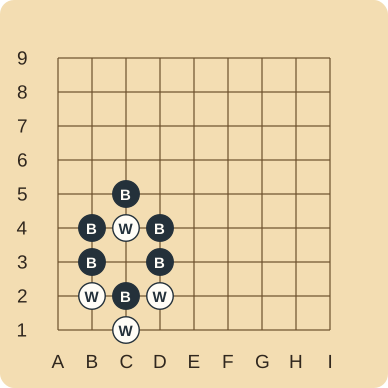
Black C2 is a single stone. White C4 is another single stone with only C3. The surrounding Black stones B4, D4 and C5 remove its other liberties. Keep those stones in the reconstruction; an extra outward liberty would change the later recapture.
This prepared parent is a teaching setup, not an asserted game history. The optional preparation below shows a checked way to place the offered Black stone, without ranking that choice against other moves.
White C3 takes one but joins a vulnerable string
White plays C3. Black C2 loses its last liberty and is captured. The new White stone connects directly to the pre-existing White C4, giving one two-stone White string.
Its only liberty is now C2, the vacated Black point. B3 and D3 are Black; B4, D4 and C5 block White C4’s other neighbours. The capture is locally accepted, but the whole resulting White string is in atari.
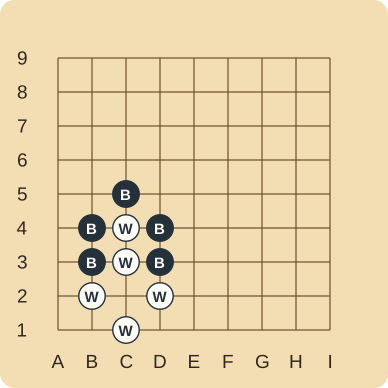
The new stone’s apparent success is therefore incomplete evidence. A gain of one prisoner does not say what the opponent can capture on the next actual turn.
Black C2 immediately captures both White stones
Black plays C2. It fills the White string’s last liberty and removes White C3 and C4 together. Black C2 then has C3 as its own liberty.
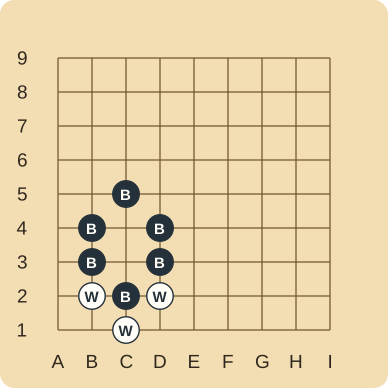
The local no-self-capture check accepts the placement after the two White stones are removed. The immediate-ko check also accepts it because the resulting board differs from the board before White C3: C4 was White there and is empty now.
This is the checked two-ply endpoint. No later chase, exact score or optimal-play conclusion is claimed. The absence of an immediate simple-ko repetition does not certify every broader history-dependent ruleset.
Compare the full-board result, not a recapture slogan
| Question | Existing simple-ko example | Snapback here |
|---|---|---|
| First capture | White C3 takes Black C2. | White C3 takes Black C2. |
| Proposed reply | Black C2 would take only White C3. | Black C2 takes White C3 and C4. |
| Compare with before White C3 | Every intersection would match. | C4 changes from White to empty. |
| Stated immediate-ko decision | Reject the proposed recapture; do not alter accepted history. | Accept the shown recapture. |
A rule check must compare complete occupancy, not just where the new stones stand. Here C2 returns to Black and C3 returns to empty, but that does not account for the additional removed White stone at C4.
Likewise, prisoner records are not a substitute for the board comparison. Record captures accurately, then apply the adopted repetition rule to the states that rule actually uses. The ko audit pack keeps a rejected proposal separate from accepted moves.
An optional original preparation supplies the offered stone
For a three-ply replay, start from the same complete parent with Black C2 omitted and Black next. All other Black and White stones stay as listed. Play Black C2, White C3, Black C2.
The first Black C2 is an accepted empty-point placement with C3 as its liberty and no capture. It produces the prepared parent above. The two later moves give the same one-then-two capture result.
This demonstrates a precise supplied preparation, not evidence that Black C2 is the strongest choice or White must take it. The single stone is offered in an original exercise; the analysis checks the displayed response rather than inventing an opponent’s intention.
Check a possible snapback in your own record
- Save the complete parent and who moves next.
- Count the offered string and its actual last liberty.
- Apply the first capture and remove every captured stone.
- Trace the capturing stone’s whole connected string; count its distinct liberties.
- Test the actual reply and its captured set.
- Compare the full result with the prior board required by your repetition rule.
Download the complete parent, every state, capture sets and board-difference audit. The optional preparation is separately labelled. Do not append an unverified later line to the endpoint.
Practice: Which one point proves this immediate reply does not restore the parent? C4. It began with a White stone and is empty after Black’s two-stone reply. For a different capture trap, use the whole-string countercapture check.
Sources and further reading
- BGA: capture, no-self-capture and immediate koFull relevant introduction read 5 November 2026; all original finite placements use this declared local convention.
- Sensei’s Library: SnapbackCurrent full text read 5 November 2026; page last edited 7 June 2026. Used for the larger-recapture concept, not copied diagrams or professional-game claims.
- BGA terminology: uttegaeshiRelevant entry identifies snap-back; the original board and capture arithmetic are separately verified.