Practical guide
Xiangqi Elephant Eyes: Check the Blocker, River and Destination
An elephant’s eye is the midpoint of its two-intersection diagonal move. Any piece on that midpoint blocks the route. An empty eye is only the first test: the elephant must stay on its own side, land on an available point and leave its general safe.
Find the midpoint before judging the move
For an elephant on e2 proposing g4, the displacement is two files and two ranks. Its eye is f3: one diagonal step in the same direction. The elephant does not travel through f2 or e3, and it does not have the horse’s orthogonal first step. Check the particular proposed destination before naming a blocker.
Article 2.3 of the cited World Xiangqi Rules requires this two-point diagonal movement, prohibits river crossing and says that either a friendly or opposing piece occupying the eye blocks the move. Article 2.8 separately forbids landing on a friendly piece. Those are different reasons for rejection. [1]
An enemy at the eye cannot be captured during a move to the far endpoint. An enemy at the endpoint can be captured if the eye is empty and the remaining conditions pass. The useful explanation therefore names both intersections, rather than saying only “there is a piece nearby”.
Read the complete board and the coordinate view
Every board uses a fixed view from Red’s side: files a–i run left to right; ranks 0–9 run from bottom to top. The river is between ranks 4 and 5. Red’s palace is files d–f, ranks 0–2; Black’s is d–f, ranks 7–9. These worksheet coordinates differ from player-relative notation and from software that begins ranks at 1.
Pieces sit on intersections. The prefix r means Red and b means Black; G is general, E elephant, S soldier, H horse, C cannon and R chariot. Every listed position includes both generals and every occupied intersection. Unlisted points are empty. Colour is reinforced by written piece labels. [1]
These are original sparse teaching positions. They demonstrate the rules on the supplied board, rather than a documented route from the initial array or a historical game. Treat each proposal as a fresh alternative unless a numbered sequence explicitly includes the other player’s reply. No claim about an opening win, repetition history or event penalty is made.
Keep the elephant eye separate from a horse leg
On a narrow screen, scroll this table sideways. Keyboard users can focus it and use the arrow keys.
| Proposed piece move | Intermediate point | What blocks it |
|---|---|---|
| Elephant e2–g4 | f3: first diagonal midpoint | Any piece on f3. |
| Horse e2–f4 | e3: first orthogonal leg | Any piece on e3. |
| Horse e2–g3 | f2: first orthogonal leg | Any piece on f2. |
These rows compare route geometry, rather than complete legal positions. The complete exercise boards below supply the missing generals and other occupied points. In a full move, route clearance alone never replaces the general-safety check.
For an elephant moving the other way, reverse both diagonal components. For example, g4 to e2 still uses f3. Both colours follow the same midpoint rule. Which half the elephant may occupy depends on its side; Black’s own half is ranks 5–9 in this view.
Try seven complete elephant positions
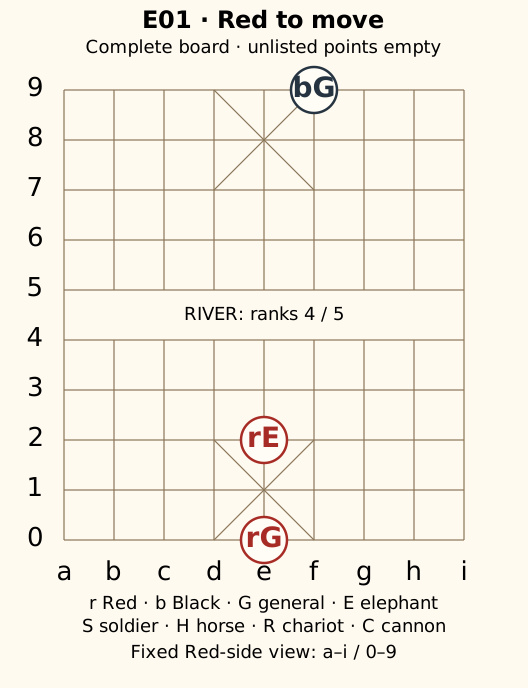
E01: An open eye
Complete position: e0 rG, e2 rE, f9 bG. All other intersections are empty. Red to move.
Check these proposals independently from the unchanged board: e2–g4.
Show the answer and reasoning for E01
e2–g4 is allowed.
The displacement is +2 files, +2 ranks; midpoint f3 is empty; g4 stays on Red rank 4; both generals remain safe. Write “eye f3 empty; destination g4 empty; own half; general safe” before accepting the move. This identifies what would have to be rechecked in a changed position.
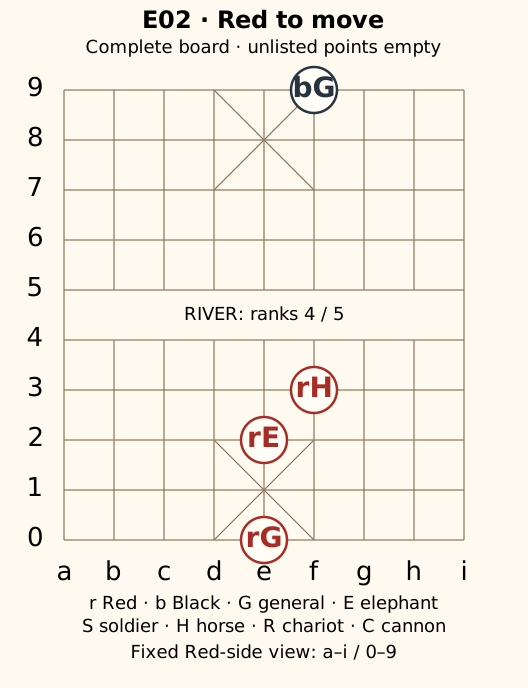
E02: A friendly eye blocker
Complete position: e0 rG, e2 rE, f3 rH, f9 bG. All other intersections are empty. Red to move.
Check these proposals independently from the unchanged board: e2–g4.
Show the answer and reasoning for E02
The horse on f3 blocks the eye.
f3 is the midpoint; the friendly horse is not a landing piece and cannot be jumped. Do not remove the friendly horse to make the proposal work. Moving that horse would be a different turn and a different board.
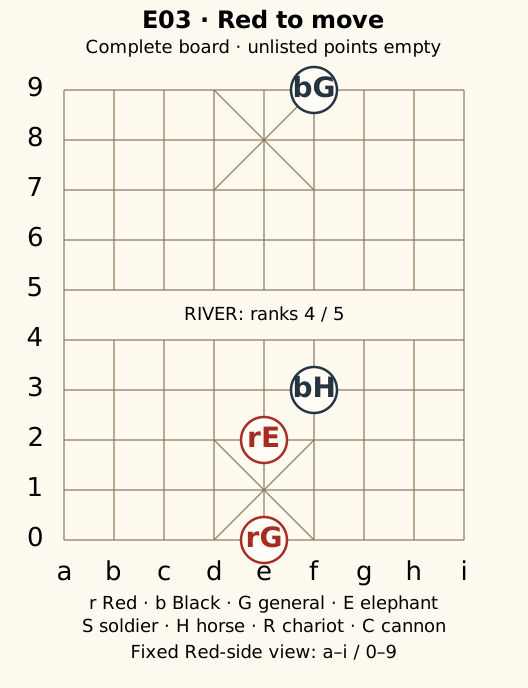
E03: An enemy eye blocker
Complete position: e0 rG, e2 rE, f3 bH, f9 bG. All other intersections are empty. Red to move.
Check these proposals independently from the unchanged board: e2–g4.
Show the answer and reasoning for E03
The black horse on f3 also blocks the eye.
A capture would occur at g4, not at f3; an enemy midpoint cannot be captured along the route. Compare E02: the blocker’s colour changes but the eye condition does not. The elephant cannot capture f3 while finishing on g4.
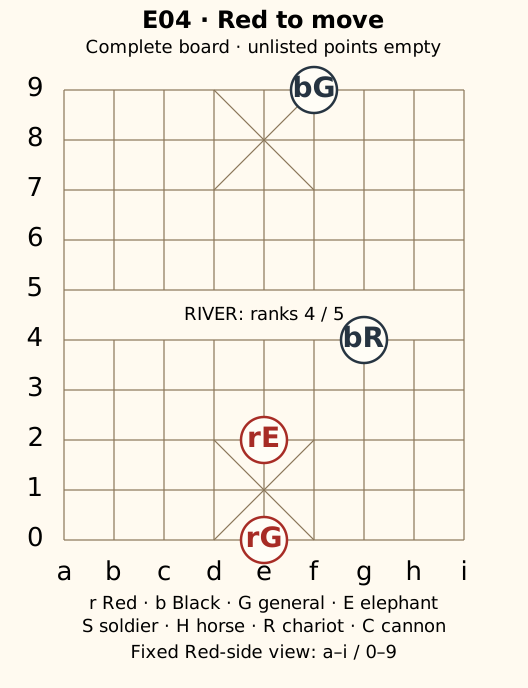
E04: Capture at the destination
Complete position: e0 rG, e2 rE, f9 bG, g4 bR. All other intersections are empty. Red to move.
Check these proposals independently from the unchanged board: e2–g4.
Show the answer and reasoning for E04
Red captures the chariot at g4.
f3 is empty; the enemy stands at the landing point; only g4 bR is removed; generals remain safe. The new piece list replaces e2 rE and g4 bR with g4 rE. No midpoint piece is removed because f3 was empty.
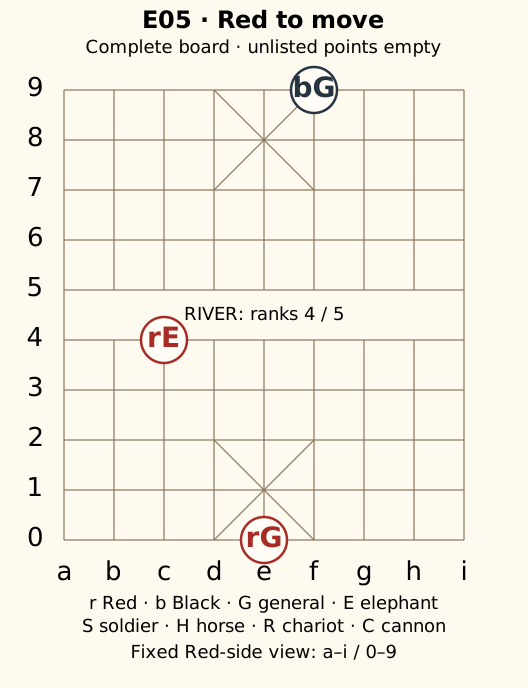
E05: Empty eye across the river
Complete position: c4 rE, e0 rG, f9 bG. All other intersections are empty. Red to move.
Check these proposals independently from the unchanged board: c4–e6.
Show the answer and reasoning for E05
The move is rejected for crossing the river.
The midpoint d5 is empty, but the Red elephant would land on rank 6 outside its own half. A crossing proposal can have a correct diagonal shape and an empty midpoint. Keep “river boundary” as its actual failure reason.
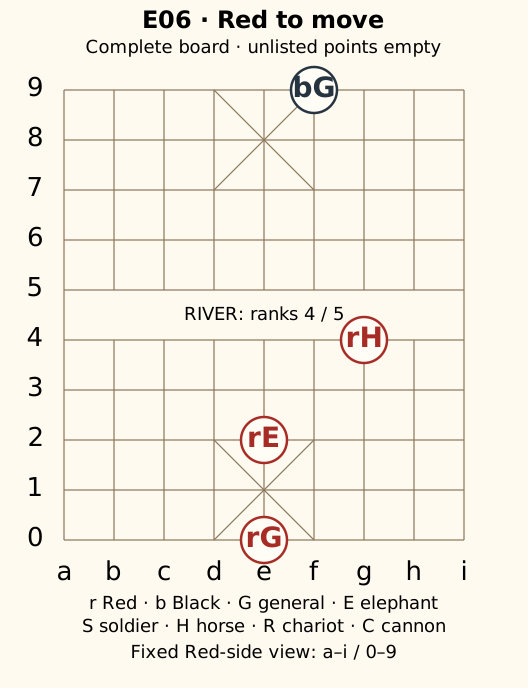
E06: Friendly destination
Complete position: e0 rG, e2 rE, f9 bG, g4 rH. All other intersections are empty. Red to move.
Check these proposals independently from the unchanged board: e2–g4.
Show the answer and reasoning for E06
Red cannot land on its own horse.
The empty eye does not override friendly destination occupancy. Do not call this a blocked eye. The blocker is at the destination, so record friendly occupancy instead.
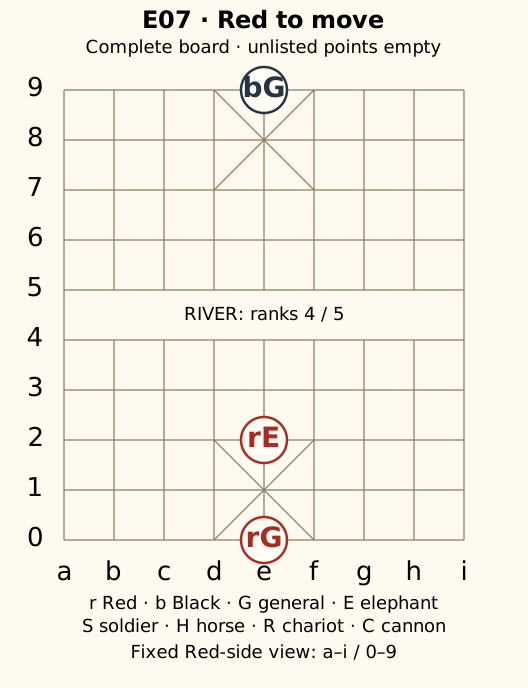
E07: Eye passes but the general is exposed
Complete position: e0 rG, e2 rE, e9 bG. All other intersections are empty. Red to move.
Check these proposals independently from the unchanged board: e2–g4.
Show the answer and reasoning for E07
The move would expose facing generals.
e2 is the only e-file blocker; after moving to g4 there would be no occupied point between e0 and e9. The midpoint f3 and landing point g4 are empty, but e2 was separating the generals. The rule has to be checked on the resulting board, not only before moving.
Use a move-check sequence that preserves the reason
- Name the side, exact source and destination. Check that both points are on the board and the source contains that side’s elephant.
- Confirm a displacement of exactly two files and two ranks. Calculate the midpoint by taking one diagonal step toward the destination.
- Read the midpoint’s occupancy. If a piece is there, stop and name it as the eye blocker.
- Check that the destination remains in the elephant’s own half and does not contain a friendly piece.
- Construct the resulting board for a remaining proposal: move the elephant and remove only an opposing destination piece.
- Trace attacks on the moving side’s general, including the shared file between the generals. Accept only if that general remains safe.
Recompute the eye after the elephant moves. A blocker relevant to e2–g4 need not block the next proposed diagonal. Similarly, a clear eye in a partial drawing cannot certify a move when the general or another attacking piece is missing.
Practise the explanation as well as the yes/no answer
An elephant has an empty eye. Is that enough to allow its move?
No. The river, destination and general-safety conditions are still separate.
Compare E05, E06 and E07. All can have an empty eye, but each fails for a different reason. A useful correction must address that reason instead of moving an unrelated neighbouring piece.
An enemy horse sits at the eye. Can the elephant take it and continue?
No. The horse blocks the route; it is not at the proposed destination.
Compare E03 with E04. The former enemy is at f3, while the latter enemy is at g4. Ordinary captures remove the destination piece, not an intermediate eye blocker.
Keep the board, proposal and result together
Download the complete positions and explained answers. The text file includes fixed coordinates and FEN; the page’s board links open the original SVGs. Keep the coordinate convention with any board you print.
For each attempt, record the eye coordinate, its occupant, the destination’s side of the river, any capture and the final general-safety result. Keep rejected proposals on the original board. A guessed after-board for an illegal move should never be used as the start of a “winning” continuation.
Continue with the file-blocker lesson when a correct elephant shape still exposes a general. To practise the different intermediate point used by a horse, open the horse-leg worksheet.
Sources and further reading
- World Xiangqi Federation: World Xiangqi Rules, 2018 English editionChapter 1, PDF pages9–14 / printed pages1–6. Board, piece movement, general safety and ordinary checkmate/stalemate outcomes. Event-specific repetition and penalties require the adopted rules.
- Xiangqi.com: Pieces and MovesA second beginner explanation of elephant eyes, soldier crossings and palace boundaries. Platform timer behavior is outside this lesson.