Practical guide
Facing Generals in Xiangqi: Check the File After Every Move
The two generals cannot face each other on the same file without an intervening piece. Check that file on the resulting board after a proposal. A piece of either colour can block it, and moving the last blocker away can make an otherwise correct move illegal.
Inspect the after-board, not only the moving piece
Locate both generals. If they occupy different files, the direct facing-generals condition is absent, but other attacks still matter. If they share a file, list every occupied intersection strictly between them. At least one intervening piece prevents their direct line; an unobstructed line is forbidden by Article 2.9 of the cited rules. [1]
The blocker can belong to either side and can be any piece. Its role here comes from its occupied point, not its material value or colour. When a proposed move changes that point, you must recalculate the list after moving and capturing.
A move can therefore pass a cannon screen, horse leg or soldier direction test and still fail general safety. Keep the two conclusions separate: “the piece could move that way” does not mean “the full move is legal”.
Read the file and the complete piece list
Every board uses a fixed view from Red’s side: files a–i run left to right; ranks 0–9 run from bottom to top. The river is between ranks 4 and 5. Red’s palace is files d–f, ranks 0–2; Black’s is d–f, ranks 7–9. These worksheet coordinates differ from player-relative notation and from software that begins ranks at 1.
Pieces sit on intersections. The prefix r means Red and b means Black; G is general, E elephant, S soldier, H horse, C cannon and R chariot. Every listed position includes both generals and every occupied intersection. Unlisted points are empty. Colour is reinforced by written piece labels. [1]
These are original sparse teaching positions. They demonstrate the rules on the supplied board, rather than a documented route from the initial array or a historical game. Treat each proposal as a fresh alternative unless a numbered sequence explicitly includes the other player’s reply. No claim about an opening win, repetition history or event penalty is made.
In these boards the shared file is usually e, with Red’s general on e0 and Black’s on e9. The relevant intervening points are e1 through e8. Neither general’s endpoint counts as a blocker. Empty points and the river band are not pieces.
Ask what still occupies the file after the proposal
On a narrow screen, scroll this table sideways. Keyboard users can focus it and use the arrow keys.
| Proposal type | After-board question | Typical result |
|---|---|---|
| Sole blocker leaves sideways | Is any other piece left between the generals? | If none remains, reject the exposure. |
| Blocker moves along the same file | Does it still lie strictly between them? | The direct block may remain; check other attacks. |
| One of two blockers leaves | Which other occupied point survives? | A surviving piece can still block. |
| Capture lands on a blocker | Does the capturing piece now occupy that point? | Ordinary capture replaces, not empties, the point. |
The last row is an easy mistake. A chariot arriving from another file to capture a blocker does not remove all occupancy at that destination. The captured piece disappears, but the chariot now stands there. Recompute the exact after-board instead of saying vaguely that a blocker was “removed”.
Try five complete file-blocker audits
F01: Move along or away from the file
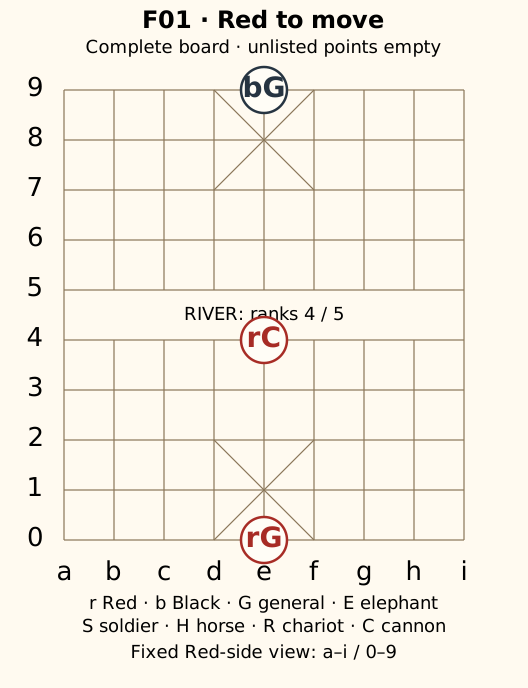
Complete position: e0 rG, e4 rC, e9 bG. All other intersections are empty. Red to move.
Check these proposals independently from the unchanged board: e4–f4; e4–e5.
Show the answer and reasoning for F01
Along-file movement preserves the block; sideways movement removes it.
The cannon is the sole blocker and has no capture screen toward either general. No screen is needed for the quiet e4–e5 move. Do not remove the cannon from the file merely because it moves. At e5 it is still strictly between the generals. These are two alternative quiet proposals from the original board.
F02: Another blocker survives
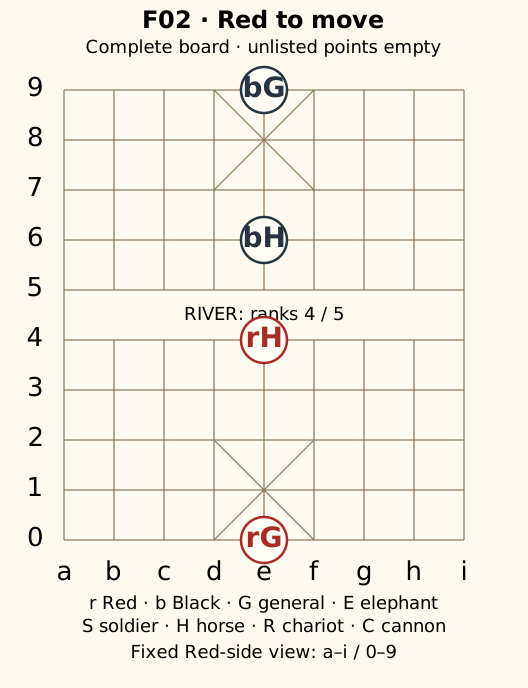
Complete position: e0 rG, e4 rH, e6 bH, e9 bG. All other intersections are empty. Red to move.
Check these proposals independently from the unchanged board: e4–g5.
Show the answer and reasoning for F02
The horse may leave because e6 remains occupied.
The horse uses empty f4 as its leg; Black horse e6 remains strictly between the generals. No other enemy attack on e0 appears. The surviving e6 horse belongs to Black, but still interrupts the generals’ line. The Red horse’s move also needs its own empty f4 leg, which this board supplies.
F03: An outside capture replaces the blocker
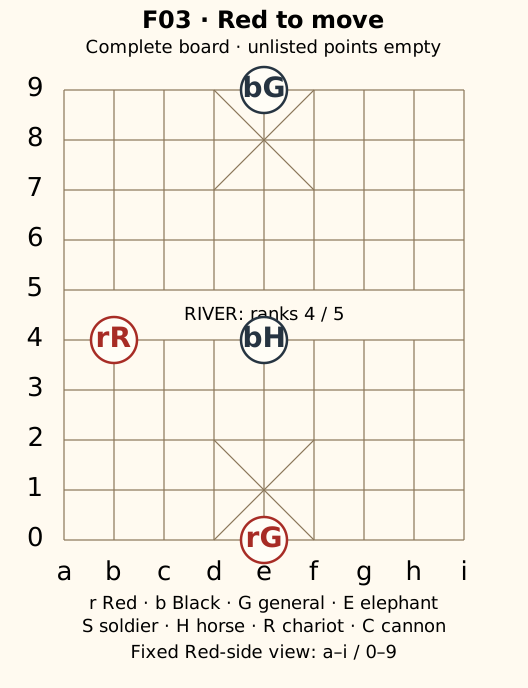
Complete position: b4 rR, e0 rG, e4 bH, e9 bG. All other intersections are empty. Red to move.
Check these proposals independently from the unchanged board: b4–e4.
Show the answer and reasoning for F03
The capture preserves a blocker on e4.
The chariot captures the horse at e4 and now occupies e4 itself. It gives a chariot check to Black; it does not leave facing generals. After the capture, the pieces are e0 rG, e9 bG and e4 rR. Red’s general is safe. The chariot at e4 now checks Black by its ordinary clear file; Black must respond on the next turn. Blocking the generals’ direct line does not prevent a chariot attack.
F04: A Black blocker has the same duty
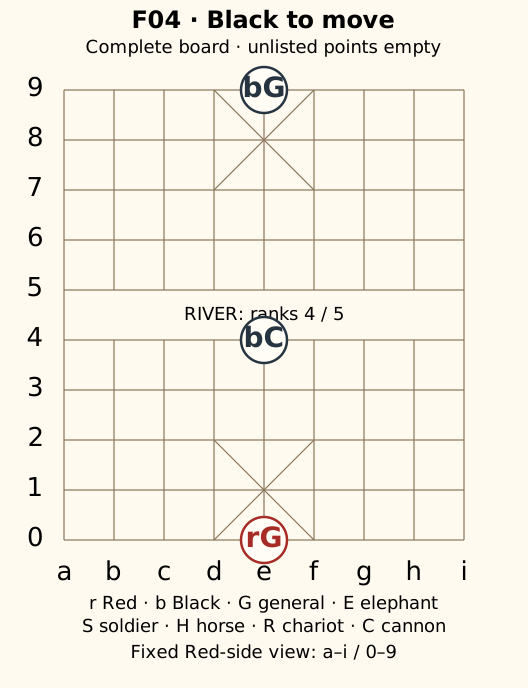
Complete position: e0 rG, e4 bC, e9 bG. All other intersections are empty. Black to move.
Check these proposals independently from the unchanged board: e4–f4; e4–e5.
Show the answer and reasoning for F04
The rule also rejects Black moving the final blocker sideways.
Colour does not determine whether a point blocks the file. Black may move the cannon along the clear file while keeping both generals separated. Black has the same obligation to leave its general safe. An enemy general is not a legal target to capture in these exercises; reject the exposure before treating it as a continuation.
F05: The general steps to another file
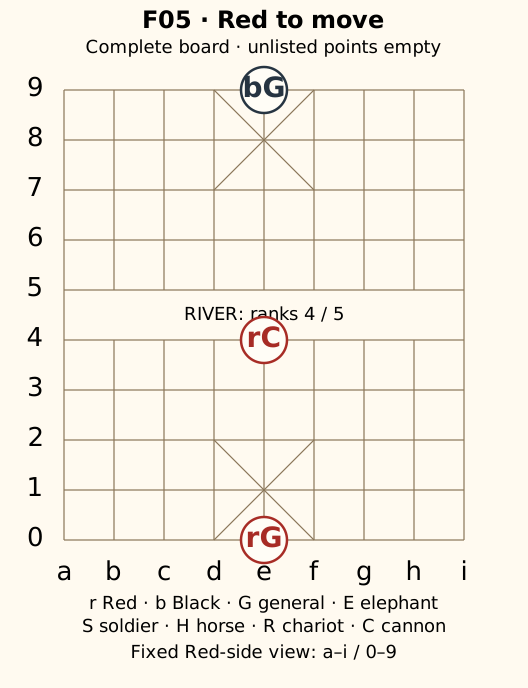
Complete position: e0 rG, e4 rC, e9 bG. All other intersections are empty. Red to move.
Check these proposals independently from the unchanged board: e0–d0.
Show the answer and reasoning for F05
The general may legally step to d0.
d0 is one orthogonal step within Red palace. The generals then have different files, with no other enemy attack on d0. The new Red point d0 is inside the palace and is not attacked on this sparse board. A different board might have a chariot or horse covering d0, so do not turn this one example into an automatic escape rule.
A file duty is not total immobility
People often call a last blocker pinned. The useful statement is the move-specific one: that proposal may not expose the general. A blocker may have an along-file move that retains occupancy, or another friendly move may change the general’s file. Conversely, a surviving blocker may preserve the direct line while some other attack still makes the move illegal.
Compare F01’s two cannon proposals and F02’s remaining Black horse. Those boards show why “this piece is pinned, so it can never move” is too broad. Compare F03 too: the blocker survives as a different piece and the attacking situation changes.
For actual play, inspect every enemy piece’s resulting attack. A cannon requires its exact screen; a horse its exact leg; a chariot a clear line. General safety is a full-board condition, not a one-file shortcut. [1]
Correct a rejected proposal without inventing a board
- Keep the original board and name the exact move that was rejected.
- List the original blockers and the blockers that would survive on the resulting file.
- If the last blocker would leave, mark the resulting facing-generals exposure.
- Consider only an actual alternative legal move from the original board; do not silently add a piece or change the opposing general’s position.
- For any alternative, repeat movement, destination and every general-safety check. A direct-file fix can still expose another attack.
Does a blocker of the opponent’s colour count?
Yes. Occupancy of either colour interrupts the direct line.
F02 and F04 make the colour distinction visible. Both sides must judge their own general after moving; the rule is not a benefit reserved for a friendly blocker.
Does capturing a file blocker from the side necessarily expose the generals?
No. The capturing piece normally lands on the same file point.
F03 replaces the Black horse with a Red chariot on e4. The direct block remains, but the new chariot also gives its own check. Keep those two attacks separate.
Save the before/after blocker list
Download the complete positions and explained answers. The text file includes fixed coordinates and FEN; the page’s board links open the original SVGs. Keep the coordinate convention with any board you print.
Record both general coordinates, the complete occupied list, the side to move, the proposed relocation or capture, and every surviving blocker. Then record any other attacks on the moving side’s general. This is more useful than a yes/no statement with no board attached.
The cannon-screen lesson adds a separate capture route that passes its screen count but exposes the generals. The end-condition lesson shows how the same file restriction can remove an apparent general escape.
Sources and further reading
- World Xiangqi Federation: World Xiangqi Rules, 2018 English editionChapter 1, PDF pages9–14 / printed pages1–6. Board, piece movement, general safety and ordinary checkmate/stalemate outcomes. Event-specific repetition and penalties require the adopted rules.
- Xiangqi.com: Pieces and MovesA second beginner explanation of elephant eyes, soldier crossings and palace boundaries. Platform timer behavior is outside this lesson.