Practical guide
Xiangqi Check, Checkmate and Stalemate: Three Complete Boards
Ask two questions: is the side-to-move general in check, and does that side have any legal move? Check with a legal response is ordinary check. Check with no response is checkmate. No check and no legal move is stalemate; both terminal cases lose under the cited World Xiangqi Rules.
Classify the position with two questions
“Check” describes a threat to the general that must be resolved. It does not say that every response fails. A player in check may move the general to safety, capture the checking piece or block its attack when the resulting move is legal. Against a cannon, removing a friendly screen can also resolve that particular attack. [1]
On a narrow screen, scroll this table sideways. Keyboard users can focus it and use the arrow keys.
| General currently checked? | Any legal move? | Classification |
|---|---|---|
| Yes | Yes | Check with at least one legal response. |
| Yes | No | Checkmate: the checked side loses. |
| No | No | Stalemate: the side with no legal move loses. |
| No | Yes | Neither checkmate nor stalemate. |
Article 2.11 identifies the no-legal-move condition; Article 3.1. A lists both checkmate and stalemate as losing outcomes. A stalemate draw borrowed from international chess gives the wrong result for these Xiangqi positions. The lesson uses the linked 2018 English edition’s ordinary outcome provisions; it does not determine a tournament’s repetition, time or penalty decision. [1]
Supply all pieces and the side to move
Every board uses a fixed view from Red’s side: files a–i run left to right; ranks 0–9 run from bottom to top. The river is between ranks 4 and 5. Red’s palace is files d–f, ranks 0–2; Black’s is d–f, ranks 7–9. These worksheet coordinates differ from player-relative notation and from software that begins ranks at 1.
Pieces sit on intersections. The prefix r means Red and b means Black; G is general, E elephant, S soldier, H horse, C cannon and R chariot. Every listed position includes both generals and every occupied intersection. Unlisted points are empty. Colour is reinforced by written piece labels. [1]
These are original sparse teaching positions. They demonstrate the rules on the supplied board, rather than a documented route from the initial array or a historical game. Treat each proposal as a fresh alternative unless a numbered sequence explicitly includes the other player’s reply. No claim about an opening win, repetition history or event penalty is made.
The first three boards give Red only its general on e0. That makes an exhaustive response check small enough to show completely. From e0, the geometric one-step palace destinations are d0, e1 and f0. A step to e−1 leaves the board; diagonal steps are not general moves. Each remaining destination must still be safe.
In a larger position, other Red pieces may resolve a check or simply make a safe move. No-move classification must enumerate the whole side, not just its general. A picture without a turn label cannot settle which player is facing the condition.
Compare three main boards and two counterexamples
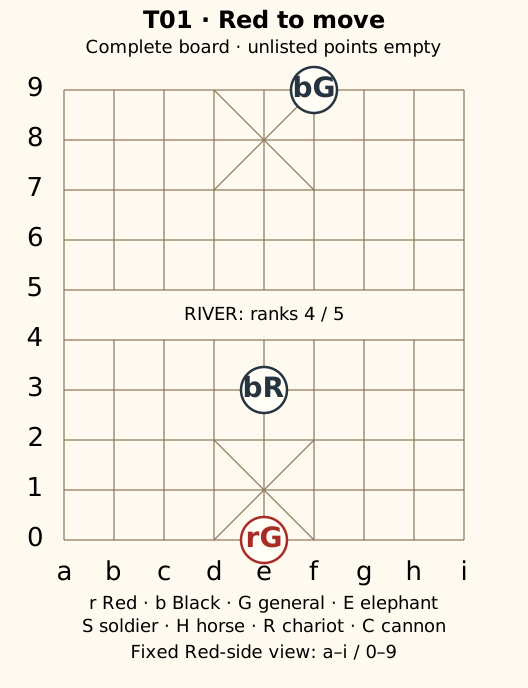
T01: Check with one legal escape
Complete position: e0 rG, e3 bR, f9 bG. All other intersections are empty. Red to move.
Check these proposals independently from the unchanged board: e0–d0; e0–e1; e0–f0.
Show the answer and reasoning for T01
Check, not checkmate.
e3 chariot checks e0; e1 remains in its line; f0 would face f9; d0 is safe. The full legal-response list is e0–d0 only. The single escape is enough to disprove mate; no best-move or eventual winning claim follows.
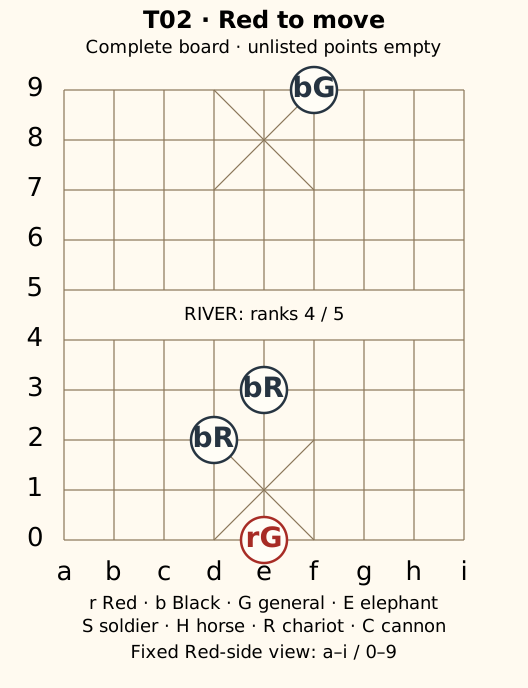
T02: Checkmate
Complete position: d2 bR, e0 rG, e3 bR, f9 bG. All other intersections are empty. Red to move.
Check these proposals independently from the unchanged board: e0–d0; e0–e1; e0–f0.
Show the answer and reasoning for T02
Checkmate: Red loses.
e3 chariot checks e0 and e1; d2 chariot attacks d0; f0 faces f9. There are no other Red pieces. All three on-board orthogonal palace candidates fail. There is no other Red piece that could capture or block the checker. Both required conditions hold: Red is checked, and Red has no legal move.
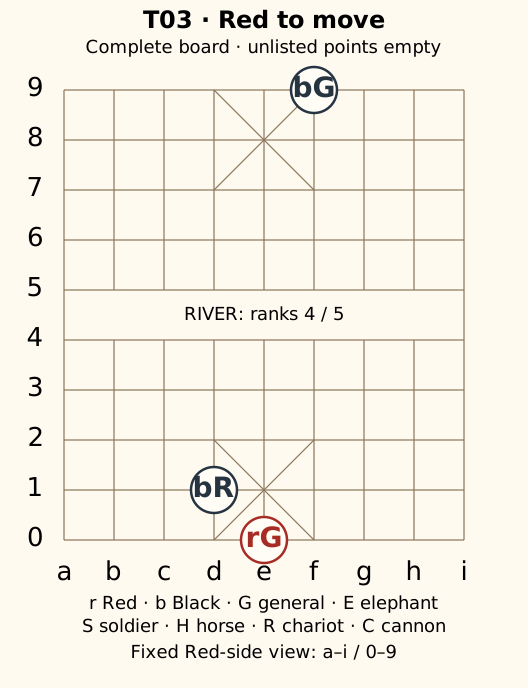
T03: Stalemate without check
Complete position: d1 bR, e0 rG, f9 bG. All other intersections are empty. Red to move.
Check these proposals independently from the unchanged board: e0–d0; e0–e1; e0–f0.
Show the answer and reasoning for T03
Stalemate: Red is not checked but has no legal move, and loses.
d1 chariot attacks d0 on its file and e1 on its rank; f0 faces f9. The chariot does not attack e0. Do not add a checking line that is not on the board. The d1 chariot lies diagonally from e0, so it does not check that point. Nevertheless, every available general step is attacked or forbidden.
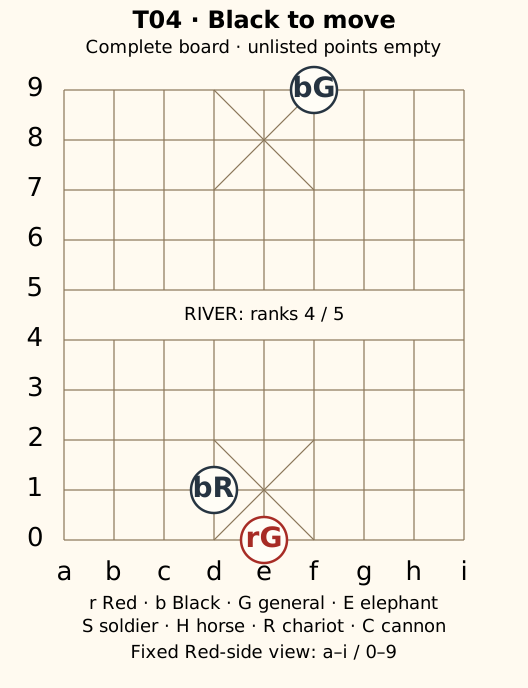
T04: The same board with Black to move
Complete position: d1 bR, e0 rG, f9 bG. All other intersections are empty. Black to move.
Check these proposals independently from the unchanged board: d1–d2.
Show the answer and reasoning for T04
Not a no-move terminal for Black.
This is a separate turn-labelled question, not a claim about the previous move. Black can play d1–d2 safely. A change of turn makes this a different question. The allowed Black move is a concrete witness that Black is not currently without moves; it is not a historical claim that the diagram arose after a particular Red turn.
T05: One additional Red horse
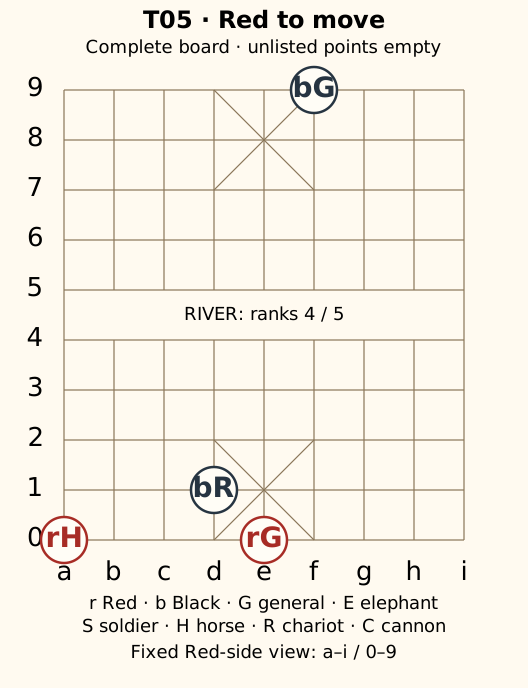
Complete position: a0 rH, d1 bR, e0 rG, f9 bG. All other intersections are empty. Red to move.
Check these proposals independently from the unchanged board: a0–b2.
Show the answer and reasoning for T05
Not stalemate: another Red piece can move.
The general still has no escape, but horse a0–b2 uses empty a1 and leaves Red general safe. Other friendly pieces must also be tested. The full extra piece is a0 rH. Its a0–b2 move is legal through empty a1, and Red was not in check to begin with. That single safe move disproves stalemate even though the general’s escape list remains empty.
Write a rejection reason for every candidate
On a narrow screen, scroll this table sideways. Keyboard users can focus it and use the arrow keys.
| Candidate | T01: check | T02: checkmate / T03: stalemate |
|---|---|---|
| e0–d0 | Safe: one legal response. | T02: d2 chariot attacks d0. T03: d1 chariot attacks d0. |
| e0–e1 | e3 chariot still attacks e1. | T02: e3 chariot attacks e1. T03: d1 chariot attacks e1 along rank 1. |
| e0–f0 | Would face Black general f9. | Both boards: would face Black general f9. |
The shared f-file is empty between a proposed Red general on f0 and Black’s on f9. That makes f0 unavailable even though no chariot in T01 covers it. A terminal proof must include this general-safety condition alongside the ordinary attacks.
The complete boards and these escape lists were checked with actual legal-move enumeration in pyffish 0.0.90’s Xiangqi rules, and separately compared with the stated piece routes. Only T01 has a legal Red move; T02 and T03 have none. This is a check of these supplied positions, not a claim about engine playing strength or how they arose in an opening.
A trapped general alone does not prove stalemate
T05 keeps T03’s general and attacker but adds the Red horse on a0. The general still cannot go to d0, e1 or f0. Yet the horse can move to b2, with a1 as its empty leg, while Red’s general remains safe. Red therefore has a legal move and the position is not stalemate.
When checking a full game, consider every friendly piece’s candidate moves. Reject a move if it leaves the general threatened, including exposing the generals’ direct file. If one safe move exists, the no-move proof fails. In check, that witness must also resolve the current check; an unrelated move that leaves the threat is not a response.
If I have found a checking move, must the game be won?
No. Look for legal responses on the actual resulting board.
T01 has an explicit general escape, and the existing cannon lesson has a different check resolved by moving a screen. A checkmate claim requires the absence of every legal response.
If my general has no safe square, is that automatically stalemate?
No. Test all friendly pieces and whether the general is currently checked.
T05 has no general escape but has a safe horse move. T02 and T03 instead have no other Red pieces; their different current check status separates checkmate from stalemate.
Keep ordinary board outcomes separate from event procedures
These examples classify immediate check and legal moves. They do not include a move history, timer state, arbiter warning or the rules adopted by an organiser. Those missing facts matter for repetition, chasing, time loss and technical penalties. Do not turn a platform-specific perpetual-check description into a universal rule.
For a disputed real game, preserve the complete position, whose turn it is, the full move history and the event’s rules. For the narrower question in this lesson, the supplied board and ordinary legal-move rules are enough to distinguish the three statuses. No general is actually captured in the example sequence.
Keep a classification record that another learner can check
Download the complete positions and explained answers. The text file includes fixed coordinates and FEN; the page’s board links open the original SVGs. Keep the coordinate convention with any board you print.
Write the side to move, each general’s coordinate, the current checking piece if any, all candidate moves and their exact rejection reasons. Record a legal witness when one exists. If none exists, show that the list includes every friendly piece instead of only a few apparent escapes.
Continue with facing generals and file blockers to understand the missing f0 escape. For a different legal response to cannon check, read cannon-screen position 10.
Sources and further reading
- World Xiangqi Federation: World Xiangqi Rules, 2018 English editionChapter 1, PDF pages9–14 / printed pages1–6. Board, piece movement, general safety and ordinary checkmate/stalemate outcomes. Event-specific repetition and penalties require the adopted rules.
- Xiangqi.com: Pieces and MovesA second beginner explanation of elephant eyes, soldier crossings and palace boundaries. Platform timer behavior is outside this lesson.