Practical guide
Xiangqi Soldier Moves: River Crossings, Captures and the Last Rank
Before crossing the river, a soldier moves and captures one step forward. After crossing, it can also step sideways. It never moves backward or promotes. Check the moving side’s direction, the destination and general safety before accepting any proposal.
Soldiers capture in their ordinary movement direction
A Xiangqi soldier does not use the separate diagonal-capture rule of an international chess pawn. Before crossing it captures by stepping one point forward onto an enemy. After crossing it may also capture one point left or right. The destination cannot contain a friendly piece, and the move must leave its general safe. [1]
The World Xiangqi Rules, Article 2.7, permits an adjacent forward step, adds horizontal movement after crossing and prohibits retreat. The beginner pieces-and-moves explanation also states that reaching the far rank does not promote the soldier into a different piece. [2]
Judge crossing from the soldier’s current intersection. A Red soldier on rank 4 has not crossed; it crosses by moving to rank 5. Black is reversed: rank 5 is still before crossing, and a forward step to rank 4 crosses. Being close to the printed river band is not a separate movement permission.
Keep forward directions and turn labels visible
Every board uses a fixed view from Red’s side: files a–i run left to right; ranks 0–9 run from bottom to top. The river is between ranks 4 and 5. Red’s palace is files d–f, ranks 0–2; Black’s is d–f, ranks 7–9. These worksheet coordinates differ from player-relative notation and from software that begins ranks at 1.
Pieces sit on intersections. The prefix r means Red and b means Black; G is general, E elephant, S soldier, H horse, C cannon and R chariot. Every listed position includes both generals and every occupied intersection. Unlisted points are empty. Colour is reinforced by written piece labels. [1]
These are original sparse teaching positions. They demonstrate the rules on the supplied board, rather than a documented route from the initial array or a historical game. Treat each proposal as a fresh alternative unless a numbered sequence explicitly includes the other player’s reply. No claim about an opening win, repetition history or event penalty is made.
Compare the four ordinary movement situations
On a narrow screen, scroll this table sideways. Keyboard users can focus it and use the arrow keys.
| Soldier’s situation | Forward step | Sideways step |
|---|---|---|
| Red on ranks 0–4 | Increase rank by one. | Not allowed before crossing. |
| Red on ranks 5–9 | Increase rank by one, if on board. | One file left or right. |
| Black on ranks 5–9 | Decrease rank by one. | Not allowed before crossing. |
| Black on ranks 0–4 | Decrease rank by one, if on board. | One file left or right. |
None of these rows allows retreat, diagonal movement, a two-point opening step or skipping an occupied destination. After crossing, a soldier retains sideways movement even after moving along a rank; it does not gain a route back across the river because retreat remains prohibited.
The table gives movement conditions. An enemy attack or a facing-generals exposure may still reject a move that fits a row. In particular, do not accept every crossed soldier’s sideways proposal without constructing its after-board.
Check six complete soldier positions
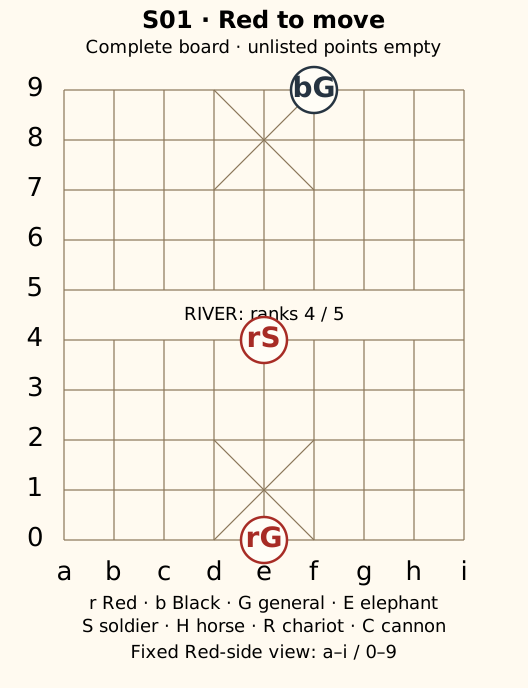
S01: Red just before crossing
Complete position: e0 rG, e4 rS, f9 bG. All other intersections are empty. Red to move.
Check these proposals independently from the unchanged board: e4–e5; e4–f4.
Show the answer and reasoning for S01
Only the forward crossing is allowed of these two proposals.
Red has not crossed on rank 4; rank 5 is the other bank. Sideways permission begins from the crossed position, not before it. The two proposals start from the same board. Do not play e4–e5 and then judge f4 as though it were the new destination; the second proposal is e4–f4 from the original position.
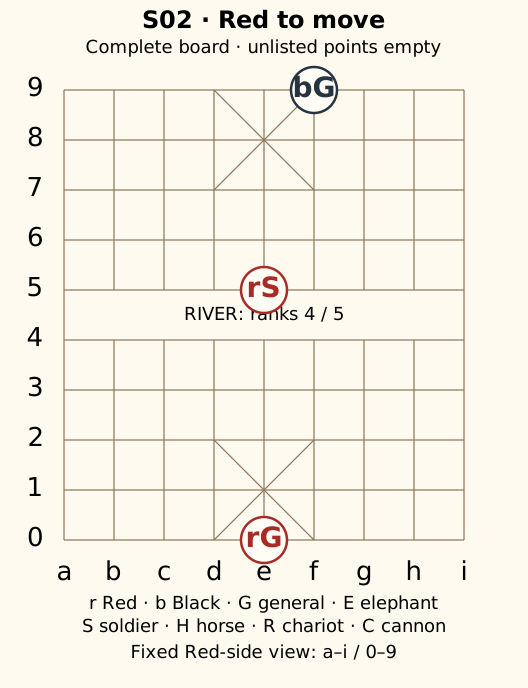
S02: Red after crossing
Complete position: e0 rG, e5 rS, f9 bG. All other intersections are empty. Red to move.
Check these proposals independently from the unchanged board: e5–e6; e5–f5; e5–e4.
Show the answer and reasoning for S02
Forward and sideways pass; retreat fails.
All proposals start from the same original board. Red increases ranks for forward; the step to rank 4 is retreat. A later move from e5 can be sideways. Crossing itself still takes one forward turn; it does not include a free lateral step.
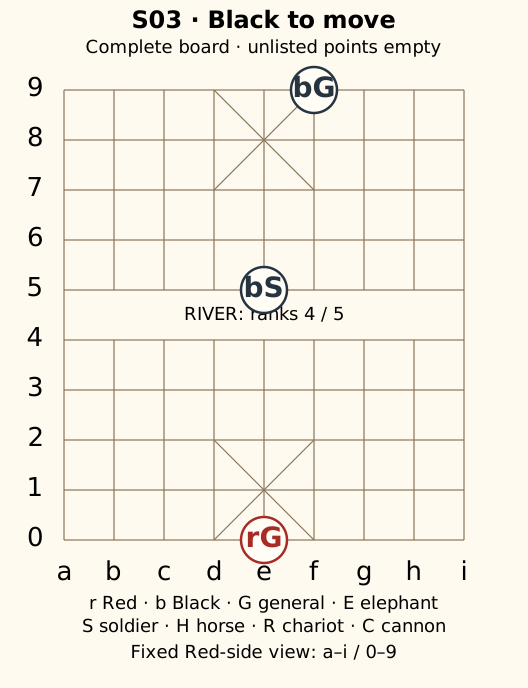
S03: Black just before crossing
Complete position: e0 rG, e5 bS, f9 bG. All other intersections are empty. Black to move.
Check these proposals independently from the unchanged board: e5–e4; e5–d5.
Show the answer and reasoning for S03
Black crosses by decreasing the rank.
Black rank 5 is not crossed; its forward step is to rank 4. Sideways d5 is unavailable here. Reading “up” as forward for both sides gives the wrong answer. Black moves toward smaller fixed ranks here.
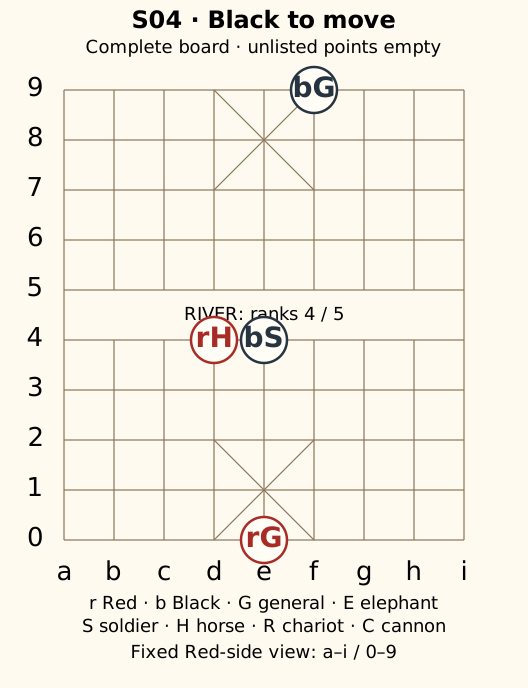
S04: Black sideways capture after crossing
Complete position: d4 rH, e0 rG, e4 bS, f9 bG. All other intersections are empty. Black to move.
Check these proposals independently from the unchanged board: e4–d4; e4–e3; e4–e5.
Show the answer and reasoning for S04
Black can capture on d4 or advance to e3; it cannot retreat to e5.
Rank 4 is crossed for Black. Capture uses the same one-step movement, with no diagonal pawn-capture rule. If Black chooses e4–d4, remove d4 rH and put the black soldier on d4. There is no diagonal capture and no jump over an intermediate piece.
S05: Red on the last rank
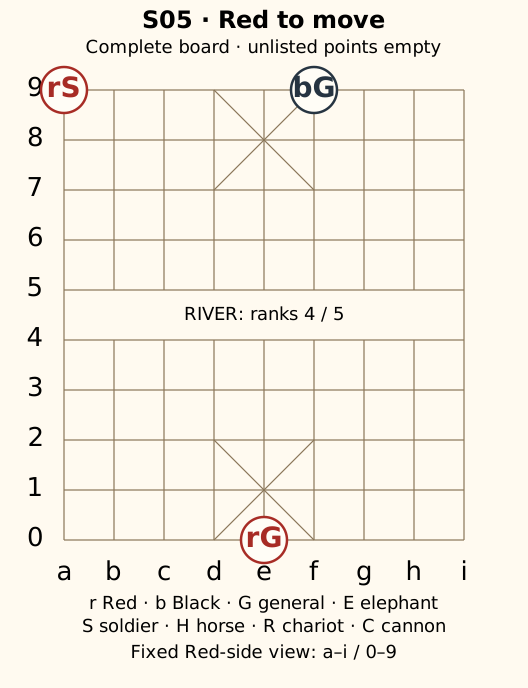
Complete position: a9 rS, e0 rG, f9 bG. All other intersections are empty. Red to move.
Check these proposals independently from the unchanged board: a9–b9; a9–a8.
Show the answer and reasoning for S05
The soldier can step sideways; it cannot retreat.
Forward would leave the board. Sideways remains possible; there is no promoted replacement piece. The allowed move leaves a soldier on b9. It does not become a chariot or queen. With a different destination occupant, the sideways permission would need a fresh occupancy and safety check.
S06: Sideways movement exposes the generals
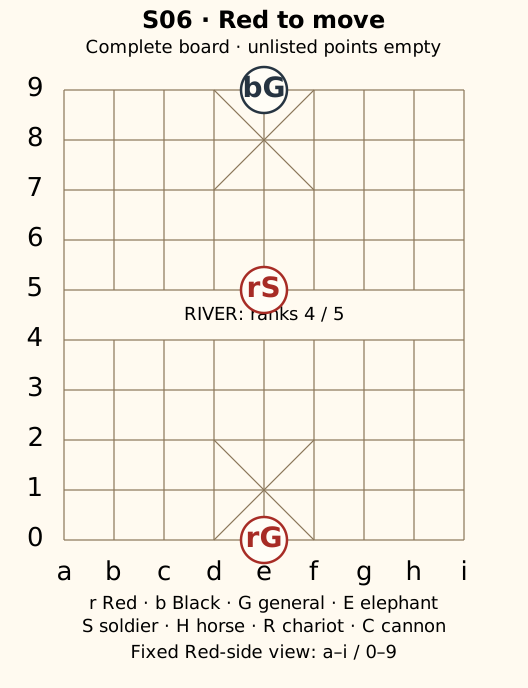
Complete position: e0 rG, e5 rS, e9 bG. All other intersections are empty. Red to move.
Check these proposals independently from the unchanged board: e5–f5; e5–e6.
Show the answer and reasoning for S06
The sideways move is illegal; the forward move keeps a blocker.
e5–f5 removes the last e-file blocker. e5–e6 retains a soldier between the two generals. Being pinned against the general does not forbid every move. The forward proposal e5–e6 still leaves a soldier between e0 and e9; the sideways one does not.
A crossing and a later sideways move take separate turns
Start from S01’s complete board. One legal three-ply teaching sequence is Red e4–e5; Black f9–f8; Red e5–f5. First Red crosses. Black then makes an ordinary one-point general move inside its own palace. On Red’s next turn, the soldier moves sideways from its crossed rank.
After this sequence the complete occupied list is e0 rG, f8 bG and f5 rS; all other points are empty. Black is then to move. This sequence was checked for each side’s ordinary legal move, and it is separate from the alternative proposals in the exercise list.
Do not omit Black’s turn and present the crossing plus sideways step as one move. A different Black reply could alter occupancy or general safety, so permission on the next turn must be judged from that actual board.
No promotion does not mean no future move
At the far rank, a soldier cannot step forward off the board and cannot retreat. It may still have a sideways move to an adjacent point. Whether that particular step works depends on the edge, destination occupant and general safety; being on the last rank is not by itself a stalemate verdict.
Likewise, a general whose own moves are blocked does not automatically have no legal move. Another soldier, horse or other friendly piece may have a safe move. The complete end-condition lesson demonstrates why every friendly piece and the side to move matter.
A crossed soldier can move sideways. Must e5–f5 in S06 be accepted?
No. It would clear the shared file between the generals.
Its ordinary direction is permitted, but its resulting general safety fails. Compare e5–e6 on that same complete board: the soldier remains an intervening piece.
Can a soldier capture diagonally like an international chess pawn?
No. Capture follows the soldier’s permitted adjacent movement.
Before crossing, use forward only. After crossing, forward or sideways can capture an enemy on the destination; there is no separate diagonal-capture permission.
Record direction, destination and the resulting board
Download the complete positions and explained answers. The text file includes fixed coordinates and FEN; the page’s board links open the original SVGs. Keep the coordinate convention with any board you print.
A useful record has the side to move, current rank, crossed status, exact source/destination, destination occupant, capture result and general-safety decision. Write “wrong direction”, “friendly destination” or “general exposed” instead of treating all failed moves as a river mistake.
For board setup and the other pieces’ river boundaries, return to the setup and river card. For the safety condition that can override sideways movement, read facing generals and file blockers.
Sources and further reading
- World Xiangqi Federation: World Xiangqi Rules, 2018 English editionChapter 1, PDF pages9–14 / printed pages1–6. Board, piece movement, general safety and ordinary checkmate/stalemate outcomes. Event-specific repetition and penalties require the adopted rules.
- Xiangqi.com: Pieces and MovesA second beginner explanation of elephant eyes, soldier crossings and palace boundaries. Platform timer behavior is outside this lesson.